
Why the world needs more imperfect environmentalists with climate advocate and social entrepreneur Natalie Chung Sum Yue


In this episode of Low to Grow, climate advocate and social entrepreneur Natalie Chung traces the path from an 11-year-old school project to becoming one of the region’s leading voices in sustainable tourism and climate education. As the co-founder of V’air, Natalie breaks down how the platform grew from a student-led digital initiative into a hands-on eco-tourism movement creating real impact on the ground.
She dives into the complexities of modern climate policy, the rise of philanthropy in funding climate solutions, and the hidden challenges social entrepreneurs face behind the scenes—from team dynamics to financial sustainability. Natalie also speaks openly about the emotional side of purpose-driven work: navigating personal relationships, coping with burnout, and learning to care for your mental health while caring for the planet.
If you’re passionate about environmental impact or building a purpose-led career, this conversation offers a grounded and refreshing take on what sustainable leadership actually looks like.
What you’ll walk away with:
- A behind-the-scenes look at building a climate-focused social enterprise as a young founder
- A clearer understanding of the gaps and opportunities in today’s climate policy landscape
- Insight into how sustainable tourism can drive meaningful climate education
- A realistic picture of team dynamics, and why interpersonal trust is a make-or-break factor
- Tools for staying adaptable when a mission-driven project evolves with V'air
- A fresh perspective on environmentalism that makes space for nuance, diversity, and real-world constraints
- Strategies for protecting your mental health while working in high-pressure, purpose-led fields
- A reminder of how meaningful relationships fuel long-term resilience and creativity
Follow Low to Grow
Instagram: @lowtogrowpodcast
Connect with Natalie on her profile page on our website!
Please Note: Low to Grow is for educational purposes only and should not be considered a substitute for professional advice. For free mental health resources, visit https://www.mind.org.uk.
Feeling motivated? Take action today by subscribing to LIFT with Low to Grow, a weekly email newsletter with my personal take on all things Mental Health X Entrepreneurship!
Natalie Chung Sum Yue (00:00)
while queuing up for a cup of coffee I started talking to this person in front of me and he actually lined up an interview with the Prime Minister of Bhutan for me during the COP, the next day.
Do you ever get frustrated at the pace of change? Totally. I always get very frustrated with the pace of change.
at some point that in the climate space is especially pessimistic
What is one misconception that you think people could have of you?
I remember missing one of my closest friend's weddings she invited me as her bridesmaid, but I couldn't make it in the end So she had to make like immediate adjustments. what I would have chosen differently if I were to choose again
Annie Wenmiao Yu (01:29)
On this episode of Low to Grow, we have someone who truly embodies what it means to turn conviction into momentum and action. Natalie Chung is a climate advocate and social entrepreneur from Hong Kong whose journey started really early. At just 18, she co-founded V'air, an award-winning social enterprise reimagining sustainable tourism as a pathway to climate education and resilience. Since then, she has carved out a remarkable global presence, earning recognition for her leadership.
while staying deeply grounded in service and impact. Natalie, for example, has represented Hong Kong at the United Nations Climate Conference, empowered youth voices in global negotiations, and also advised government councils on decarbonization, whilst contributing her expertise towards organizations like the World Bank, the United Nations, And also the World Economic Forum through the Global Shapers program.
And yes, she has even gone on an expedition to Antarctica with world renowned ocean experts to help shape a new modern day strategy for a carbon neutral future. For anyone listening to this podcast who is committed to growth and meaningful contribution to society, I strongly believe that Natalie's clarity of purpose and fearless action will be an inspiring blueprint to take forward.
Natalie Chung Sum Yue (02:49)
Natalie, who do you think our conversation today will most benefit?
I think our podcast today will benefit the most everyone pursuing their passion and dreams. No matter what age you are in, what career stage you are in, you're always open and have the flexibility and freedom to take on a side interest or pursue your passion project. So everyone who is hoping to have a career transition or just to start your community and start a new hobby is welcome to join our podcast. I am so excited to be having you on the Low to Grow Podcast, Natalie. first met
when we were both in Oxford through a Chinese dance group and I'm really glad that we've been able to stay in touch and I love seeing all the posts of your life updates and your career updates as well on Instagram. you lived in Hong Kong that's why you were born and then you moved to the UK to Oxford to do your masters and now you're at Princeton doing your PhD. I'm quite curious to understand the ethos and the theme of climate and also sustainability that's always been quite central to you. What started that interest for you?
First of all it's so amazing to catch up here in London. It's been such a long time since we last caught up. But I've been seeing your amazing posts and the work you've been championing, especially starting this new podcast. For me, I actually started discovering my passion at the early age of 11. still remember that was a school project and it's on the topic of what is climate change. And for that project, our primary school teacher very kindly invited
a
famous polar explorer in Hong Kong called Dr. Rebecca Lee. She's the first person in the world to have been to the three poles, which are the North Pole, South Pole, and Mount Everest. And she was sharing with us how the Earth is warming. she used a particular analogy, which is like the Earth is trapped in a microwave with continuous rising temperature at the verge of explosion. I think that imagery really stuck to my mind ever since and inspired me to care for the planet and do something to revert the warming.
That was maybe 2006 and 2007. ESG or climate or sustainability was not a big or dominant theme yet. So I was just trying to gain as much knowledge as possible, you know.
reading the news internationally and looking at what exactly is global warming and how is it related to climate change and extreme weather events. So I think that kind of awareness blossomed pretty early on. But when I really took tangible action was when I reached 18, when I first went to university, during my freshman year, I joined a pitching competition before COP21, where the Paris Agreement was signed. And before that, the French consulate
in
Hong Kong was trying to raise awareness among the public about climate. So they organized this preaching competition and my team and I came up with the idea of starting a local sustainable tourism company that can help motivate people to discover biodiversity in their neighborhoods and vicinity. And we started the social enterprise called V'air Sustainability Education, which is still running until today. I love that. I also love how the initiative that led you to your enterprise started at university.
What kind of activities did you first start doing when you and your team first created V'air, and how has that really changed over the years? Yeah, it seriously has been such a long journey. I can't believe it's been over around 10 years now. We now. We started around 2015. the start, we were thinking to create a website that compares Hong Kong's tourist attraction and nature scenery with global attractions.
Hong Kong also has these amazing hexagonal volcanic rocks that can be compared to world-class destinations a lot of people imagine cities as concrete jungle like New York, London and Hong Kong but actually all these cities have their sanctuaries. There are so many nice parks in London and equally in Hong Kong actually 70 % of our land is greenbelt and around 40 % of it is preserved as country parks.
we have long hit the target of 30 by 30 that globally we're talking about right now. So we really want to use these natural resources, better utilize them as educational hubs. take students outside to nature on eco tools and curating different types of nature-based experiences. That's how we started. We started with a website with information and we started getting more inquiries - like these information are amazing, but what about actually taking us outdoors and
looking
at these places, having professional tour guides to do it? it. So the model transitioned from an online presence to offline. we started with digital content creation into physical ecotours. And now we also pivoted into different fields, including research, policy advocacy, all around climate and sustainable tourism. One of the really exciting collabs we had recently was with Disneyland in Hong Kong. I was just going to ask you about that. I saw it on your Instagram. That's amazing.
Yeah, we actually launched it last year on World Environment Day, the 5th of June. It was an idea because I'm a big Disney fan and I've had the annual pass for maybe the past decade. Like every year I keep renewing it. every time I go to Disney, I look at the surrounding. Although like the whole Disneyland is built on
land that used to be nature. But after the building of the theme park, there are also lot trees being preserved and important species and biodiversity. And there are also different environmental social governance , ESG initiatives around the park. For instance, Disneyland Hong Kong is the single corporate with the largest solar panel installations on top of the Small Small World attraction. So we realized that there are these interconnections
are we able to the gap between a theme park experience and an immersive nature education asset? we talked to the management at Disney to explore if they're interested in the idea of bringing children and students of different ages into the theme park to learn about sustainability. And they're really passionate about it. So we worked for around half a year to get the content creation. We co-created the syllabus with them and infused a lot
Disney elements and Disney stories. One great example is there's this Moana celebration attraction in Hong Kong Disneyland and Moana is actually a story of a girl living in the Pacific Islands facing sea level rise issues with unsustainable fisheries. we're tying this story with the climate scenarios. So when people saw the celebration in the attraction they can connect it with lived experiences and the urgency of the climate crisis.
So it became a really good tool to convey these messages. And we also developed the whole syllabus around the UN Sustainable Development Goals. There were some water conservation ideas near the castle with their water storage tank recycling groundwater. So we tied that with the SDG on water quality. And we also tied, for example, Ironman about industry and innovation with that SDG. I love that. I love how you have managed to
Obviously
bring policy, UN SDG goals and interactive elements to that whole experience and I think especially when it's targeted for a slightly younger audience that's what will really be memorable and what they will remember as well. And I'm sure that a lot of them go there and if they read about the V'air story they will be very much inspired by you as well. Hong Kong achieving 30 by 30, that's not the case for all countries in the
the world at the moment. So for in certain Western countries at the moment, ESG funding is a bit lower than what they used are your thoughts on that? Because I know that at the moment your PhD at Princeton is focused climate related policy. Yeah, so currently I'm doing my PhD at Princeton on climate policy. Specifically, I'm looking at how nature-based solutions help flood risk reduction which is
a part of climate change adaptation. I think you're right, like in European markets, we saw some of the funding retreating from renewable energy technologies and other climate tech. And in the US, appetite on ESG funds have also been decreasing with the new administration, a lot of the legal federal changes, as well as corporate backlash, or like not committing or even retrieving their ESG targets.
But I do see a trend that has been quite consistent in Asia. Companies are still very committed towards the net zero targets that they've set. And in the US, even though the overall federal government is discouraging, a lot of states are still putting a lot of work into green tech and sustainability related measures and legal frameworks, such as California, like New York City. Last month, I was at New York
Climate
Week one of the organizers from the Climate Group mentioned that actually before September 2025, they were really scared New York Climate Week has been an annual event, I think for the past 10 years. And this year, they were worried that since the Trump administration, they won't be able to do it at this scale. But in the end, they actually managed to exceed the number of events compared with last year. So we're seeing really a corporate uprising and a lot of
grassroots movements happening despite the federal lack of attention or lack of funding or support. Philanthropy is filling a big gap in the space and even in some of the UN dialogues at COP meetings, the UN climate change conferences, I was hearing how countries were thinking how to fill the gap if the US really retreat or withdraw from the Paris agreement, which Trump has declared to do, but I think now it's still on.
undergoing
legal procedures, like whether they actually withdraw from it. I think philanthropy will increasingly play a role in climate funding and also grassroot organizations doing re-granting, which is essentially getting a bigger grant by a nonprofit and re-granting it to indigenous communities to support their smaller projects. I think this is a trend in philanthropy space because even in Hong Kong, a lot of
philanthropic funding are quite difficult to be achieved. You have to have a very well established track record, you have to have all the legal documents and write a complicated proposal. But if we have more organizations re channeling these grants to smaller community organizations, that would definitely benefit the grassroots movements and help build smaller communities to support decarbonization and loss and damage. How does this affect your plans for V'air in the future?
and your own
plans after you finish your PhD? So for V'air, we've been a self-sustaining social enterprise for the past, think three, four years. So it's really good to see that we currently don't need to rely on any government grants or philanthropic grants to sustain our running. But in the past, maybe in the last year, it's been really difficult to get secure corporate deals because we used to do different like ESG training for companies.
scientific
workshops, as well as corporate branding exercises around sustainability. But now they're restricting their budgets on the spending because of the economic downturn. we hope that this market will flourish in the next couple of years. And we're also hoping to do more on the intersection of digital technologies like AI and VR on climate education, because we see a lot of digitalization in the edtech space.
and potentially we could also do some hybrid format of digital and in person experiences. In the past, there's been a surge of cloud tourism during COVID. When people weren't able to travel abroad, we can bring experiences, inspirations from nature from Hong Kong to the rest of the world. I think that's also an angle that we're hoping to address. another big focus is probably on gender equality and women empowerment.
We know that a a lot of girls or women lack climate education and due to low education level, they may not be able to unleash their full entrepreneurship. So in recent years, we've also been doing more capacity building exercises for different communities, marginalized groups, nonprofits, and channeling more funds from the corporate earnings into our more charitable initiatives. So I think it's a good way to sort of redistribute resources in the society to those
who are most in need and most vulnerable under the climate crisis. Thank you for sharing that. And it sounds like you're absolutely doing incredible and also needed work. I'm so happy to hear that for the past few years V'air has self-sustaining social enterprise. I think a very critical milestone for most businesses and for most enterprises. Congratulations on doing that, all the while working and also studying at Oxford and Princeton.
how has it been running the Social Enterprise for the past 10 years whilst excelling academically? That's a great question. I want to throw it back to you because you've also been doing this amazing startup I think for me, me, time management is critical. I've been trying to balance different commitments and roles and responsibilities,
and I think it's really about
spending your energy in where it's most needed. Although I'm very much a perfectionist, like growing up I remember correcting my cursive writing, like writing it again and again to get the perfect version. But as I started to grow older, I realized that it's important to divert your energy and achieve an optimal level of commitment and energy in different projects. And don't, strive for that last mile. If something's not
take a pause and work on another project first. that enabled me to balance different priorities at different stages of life and I'm really thankful to my co-founder as well at V'air, as he's been doing his PhD as well but in Hong Kong so we kind of like fill each other's gaps. I'm now focusing on fundraising because I'm not fully in Hong Kong the whole year but I still have some established business connections and sustainability networks.
a few months ago in June, we actually did a sustainability networking and meetup session organized with another two Hong Kong-based startups in New York. York. We were able to connect with the US market, understanding needs, and also exchange knowledge on how to run sustainability education businesses. So I think these kind of co-creation and collaboration is really good at a budding stage of an enterprise.
Although at the moment we don't have plans to expand to the US per se, it's still good to form these networks and connections and see how people are doing things differently in different markets that can inspire us at our work and look at, the next stage of development. So I'm really grateful for all the experiences and the opportunities that I get through studying abroad and really integrating these into our own corporation, operation and fundraising.
Looking back on your journey as a co-founder for the past decade, what are some of the key lessons that you've really learnt that you want to share with future budding social entrepreneurs? One of the key lessons is definitely the importance of building a team. I think nothing would have been achieved without our team's commitment, effort and passion. But over the years, honestly, there has been a lot of ups and downs. There were times when we had team members leaving.
We also had a big pool of volunteers and it was really difficult to engage some of them because some of them were still in University, they were interning with us. I think that kind of attainment is very important and one of the ways that we did it was by having like individual conversation and check-in dialogues with each other team members to understand how our mission can be aligned with a personal mission Because this is the only way that we can nurture
their personal growth and development at the same time ensure that their skillset can be contributed to the growth and success of the social enterprise. And sometimes it's not exactly aligned so we need to keep fine-tuning to find that right match and to continue on. Every year we recruit around eight to ten interns and these interns consist of high school students as well as undergrad, college students.
in the past we used to adopt this model where the interns would just do general tasks, but one year we started dividing them into different departments. So some of them were working on policy advocacy and research. Some of them are specifically working on marketing and some of them on activity implementation and project management. But then we realized that it not be the best way for them to acquire different skill sets because those interns who are staying in
social media function, they were just creating like social media posts one after another and it started to get boring in the middle of it. next year we learned from this lesson and we started to allow interns to switch departments so we had them like exchange roles in the middle of the internship and it turned out really great because they were able to apply that interdisciplinary mindset and skill set that are really helpful in changing their future career choices as well. Some of them stayed with us for a couple more years as
volunteer. Yeah, so I think it's important to be flexible and agile so that we can keep finding the right fit for everyone and also giving everyone a chance to develop a new set of skills instead of just focusing on honing their best existing skills. and I I remember for a lot of university internships in the summer, it was over 10 or 12 weeks, corporate interns
could rotate across different functions. this is a great way to get to know different functions of a company, helping them to find areas that they shine in that they didn't realize. But also I think the benefit looking back is actually an appreciation for the work done by different functions. Because I think sometimes in large corporations or maybe in the world in general, people are quite stuck or fixated in doing something within their own department.
department for a long time, I think it can be easy to lose perspective of the importance of other departments in that organisation as well. Yeah, also the big picture of thinking. Yes, for sure, definitely. So with all of the functions that you have mentioned, which are the ones that you most enjoy doing yourself personally?
I feel like I actually enjoy doing strategy development a lot. For instance,
for the Disney project, I came up with the idea and, discussed with our senior management to get the approval and buy in. Down to the implementation details, our team actually worked really hard in it. And it, and I'm not a particularly detail minded person. So they actually caught me out a lot on missing out like different executional details and getting me more grounded. So I think on a team, like back to your original question, it's important to have someone who
dreams big. Just think of crazy ideas and another person doing more execution and fine tuning of details to get things really done and executed in a smooth way. So I think I'm more of like the big picture person. Well, I really need someone to help me working out the details and implementing a project. I also really enjoy policy advocacy. advocacy, because I think at the end of the day, we need a robust
policy framework to ensure that ESG policies can help guide corporate decisions and drive nonprofit funding, the directions of philanthropy. So doing that is kind of like moving from here, like a grassroots organization, all the way up. Like it's a way how we gain access to government officials. I remember at the start, that was when I first got into policy advocacy because there is a recognized NGO environment.
group
in Hong Kong, so we started getting invited to policy consultation dialogues by the Hong Kong chief executive. We got the opportunity to comment on on on on policy such as budget allocation allocation, and initiatives around sustainable tourism and climate policy. it really allowed us to gain insight into how policy decisions are being made and what we can do as an individual organization to help push for it.
One interesting insight that I've gained across the years is that sometimes we keep asking the government to do something but it seems that they're very reluctant to do so and I remember one time talking to a policy official in the environment bureau. We We were We were asking them why can't we have compulsory climate education in the syllabus? It's so important and I guess we all know how important it is and they were saying that it was difficult for the environment bureau to convince the education bureau because
because
there isn't a public demand. Parents are not asking schools to provide climate education to their children. essentially, they were actually asking us as green groups or environmental education groups to develop syllabus and to trial these cases in civil society. And once we have a good case study, we can pitch it to the government again so that we can convince the education bureau that there's actually a need. Schools are asking for
education, but they need the policy framework to make it happen. So that's what we've been building in the past few years, really trying to develop syllabus and proving that these are successful. We've been collecting a lot of chat records and testimonials from people participating in our sustainability leadership programs, which are usually a week long, immersive sustainability tourism experience where students would go to different spots in Hong Kong, rural and urban, talk to
indigenous
villages about their needs around pre-living and about their perspectives on tourism development, and then using these insights to develop their eco-entrepreneurial idea to pitch it to the school and to the society. So I think these are good cases that we're gradually building more and more, not just us as an individual NGO, but we also collaborate with all the other groups like Rural Wildlife Fund, WWF, as well as Ocean Park
Foundation and building these smart case studies so that we can gather the efforts of the civil society to make tangible policy changes upstream. What I realized while you were talking is actually how similar what you have been doing is in a way to myself building a startup and trying to push new technology into the market . market. you described about Department of Education
and the Department of environment, how there's like a tension of a chicken and egg situation of there needing to be parent demand for curriculum change in order to justify the update of this particular curriculum. It's just pretty similar to in our company having not just to speak to our direct customers, but also their customers. then we get that push and pull. So like a two-pronged approach is to make sure that change actually happens, whether technology in my case or the curriculum in your case.
as a fellow founder. Do you ever get frustrated at the pace of change? Totally. I always get very frustrated with the pace of change.
I also feel at some point that in the climate space is especially pessimistic
because we're seeing these extreme weather events hitting hard to the most vulnerable communities. We saw the major flooding in Pakistan wiping out one third of their settlements. There are Pacific Island countries facing sea level rise and inundation of the communities. But we're still sitting air conditioned rooms in these climate dialogues and conferences. Just keep talking and make
make verbal commitments without substantial changes on the ground and people who are most vulnerable remains most affected and most vulnerable without any helpful solution in their situation. This kind of climate injustice really bothers me and sometimes I feel quite powerless in front of it.
And I also felt that, well, Hong Kong is quite privileged as a city. Like, is there still a point of us doing these awareness raising exercises here? And how do we connect the Hong Kong community with the rest of the world and contribute our power to more systemic changes and transformations?
I think it's a permanent struggle that we will have to live with. The world is still facing rising temperatures. The worst case scenario seems to be playing out. What gives me hope is the communities that are still fighting on the ground.
As long as we persist in our movement, we are able to, start from something small and gradually progress upward to the levers or like a higher leverage point.
one quote that inspired me is that "every fraction of degree is a million or like thousands of millions of lives saved." Maybe we're not able to keep temperature rise within 1.5 degrees Celsius as Paris agreements stated or even 2 degrees Celsius but preventing it from rising to 3 degrees or like 3.1 degree like every fraction of degree matters.
And I think a lot of us are also switching gears towards adaptation because we know that now, like, of course, it's important to work on mitigation, but adaptation is equally important because in 10 years time, there will be so many more climate disasters. How do we build a more resilient world so that we can future-proof our society and we can protect vulnerable communities in the future?
That is also why I switched my research from mitigation to adaptation. adaptation. At Oxford, I was actually working on energy decarbonization policies, looking at how complex systems and sort of intervention points can reduce energy sector emissions in Hong Kong and Beijing. Beijing. It was very interesting as a research topic. And I also think it created a certain level of change in the narratives around cost benefit analysis. We need to look further into feedback loops and accelerating the speed of change.
⁓
a lot of research historically has been very focused on mitigation, but not as much research efforts have gone into adaptation yet, like finding the most cost-effective solutions to prevent disaster impact and reduce the risk of disasters. That's why for my PhD I really hope to work in the intersection, finding out nature-based and nature-inspired solutions like mangroves and wetland restoration.
to support communities that don't have the money to build the billion dollar dikes or flood walls, flood gates to gates, to protect their communities and to support adaptation initiatives. That's really important work and I love how in your life overall you're contributing towards the mitigation part by laying lots of small bricks in a also then looking at
strategies beyond that and really driving forward researching that area. Natalie, when you look back at your time in Hong Kong, in Oxford and in the US, studying really intensely or trying to social initiatives or for example contributing to the World Economic Forum Global Shakers project, what are some personal skills that you feel like you've had to develop in yourself in order
to keep on delivering the best that you can to those different initiatives.
In terms of skills, I think one of the most important skills that I acquired have been making connections and being audacious with the connections. I've met a lot of people who talk about the importance of networking, both laterally and maybe upwards. But I think it's equally important to maintain the connections. I think in the past, I used to keep connecting with different people on LinkedIn, but rarely really following up or trying to seek opportunities.
or seek partnerships. But over the years, as I have been in the climate space for long enough, I've realized how important it is to find our own spaces and find our opportunities or create new ones. For example, this time when I came to London, initially it was just more like visiting friends and some of my former Oxford classmates like ourselves. But I reached out to an impact investing
startup that I worked with during my Oxford times, maybe like five years ago. I reached out to the team and looked for like collaborative opportunities. I actually like just came from their office, on a new project, like a small like thought leadership piece about investing in nature and how to drive more sustainable finance capital into nature-based solutions. So I think whenever you're brave enough to reach out, I feel like lot of more doors open . And always remember that
one door closes and another opens. I was applying for actually like Stanford and Princeton PhD, but yeah, something happened and I didn't end up going to Stanford. And at that time I was actually really sad and really stressed because I really wanted to go to Stanford to leverage their like ecosystems and I wanted to learn more about climate tech in the VC space. at Princeton, I felt that it was more academic institution, so
maybe it limited my opportunity to access these networks. But then I guess like looking back, it's not a decision to be regretted because Princeton still had really good network and the proximity to New York allowed me to be connected with the space there. even while I was interviewing for the Knight Hennessy Scholarship at Stanford, I actually made a good network there so I could still be connected with the fellow scholarship recipients or others.
scholarship finalists. So I think like making use of these I would call it residual networks, they may not be very immediate, not be my immediate classmates or circle, but these people who maybe have helped you or supported you along the way, if you're able to maintain a connection or to reach out, I think there's always something that will reap out of it and there are these like serendipitous encounters that actually blossoms into something bigger. For sure. I really love how you coined the term,
residual networks. It's so lovely and it's true, know, it's just people that you come across. Maybe that was a good feeling when you did meet them that first time and then if you just keep in touch every now and then. And I think opportunity comes from very unexpected places and I think in business and in government and in policy that's always the case. Yeah, I think one of the coolest experiences I had was at COP29 in Azerbaijan. I was tasked to film a documentary for RTUH radio television.
in Hong Kong called Climate Insight. So essentially we're documenting stories in COP29 about negotiations related to the China delegation, as well as the Green Belt and Road Initiative happening between China and Azerbaijan. We had a previous series in Dubai, COP28, and also featuring climate adaptation stories in Fiji. And actually the Fiji series came out of an internship that I did
back during my Oxford time at WWF in Singapore. It was a remote sustainable finance internship, but that former internship supervisor actually moved to Fiji working at the UN Development Program in Zuba. So I reached out to him asking, we really want to do a documentary in Fiji because we want to showcase the islanders and people who are facing the frontline climate crisis. How did they feed seal of rights? How are they protecting their villages and indigenous
cultures and communities and it worked out just because of this like internship boss that I've never met in person. We met online over like two months of internship who moved to Fiji and then we met in Fiji in person. So I think that was super interesting and again the same in Azerbaijan.
I met this person while queuing up for a cup of coffee at one of the pavilion and I started talking to this person in front of me and he happens to be one of the coordinators in Bhutan and he actually lined up an interview with the Prime Minister of Bhutan for me during the COP, the next day.
So we were able to get this high level policy finger to speak on our program to the Hong Kong audience about the connections between Bhutan and potentially Hong Kong because
is a carbon negative country and they have this network called the GZERO countries which are essentially like countries that have already achieved carbon neutrality and carbon negativity and they were thinking a lot on the lines of creating like forest carbon credits and selling it to other nations who are still very carbon intensive like Hong Kong or the US. So I think these are the really chances that appear out of nowhere but if you're a
to make good use of it. I think it really benefits your career and help you navigate this complex and interconnected world. How do you stay so composed when you're speaking with world leaders or when you're representing a really important and meaningful initiative at places such as COP?
I guess just like you, feel like you're so calm and composed. I'm following your podcast series. I feel like I'm like a duck in water. I like okay from the top, but then under the water I'm, know, sometimes frantically paddling. Yeah, I mean the same for me. Actually during my TEDx talk in Hong Kong two years ago, on climate resilience. We had to face the audience, like over a thousand audience in the theatre, and I was really nervous on the stage. I didn't expect it.
it. Because I've practiced the script maybe like a hundred times but then I remember like after speaking the first line my mind went completely blank and I forgot the rest of my script and we also didn't have a teleprompter I was about to cry because my mother was on a first row and she actually saw my like tears bubbling like just yeah in my eyes but then all of a sudden the lines came back and I continued talking like normally and very
thankfully the team cut out.
my blank moments on stage to stage fright part in the final YouTube video so it ended up looking good. But yeah, I think, I mean that's probably a metaphor for the rest of our lives. A lot of times we do encounter difficulties but we become so filtered on social media so everyone only sees the successful sides. People see that YouTube video and thought my speech went smoothly but the fact is it was actually
a lot of stuttering, it was just cut out. This is also what I feel in recent years when social media became more central to our daily lives. I think we tend to believe that everyone's life is perfect but actually everyone has their own struggles that we're not able to see in the glamorous social media world. Sometimes I also feel guilty for sort of perpetuating that narrative that everything is perfect. So I tried lecturing more
vulnerable stories and stories of failures and I realized that it actually resonated a lot better than just showing your perfect selves but equally, sometimes you just need to share some content for business purposes like you're promoting an event, it has to be positive positive. I think it's still very nuanced I'm still trying to find a way to be better at sharing vulnerabilities and be better at just sharing challenges
finding common grounds with other people. And I think this podcast is a great outlet for us to discuss more intimate issues like mental health and how does one become more resilient mentally and to overcome these challenges in life. Thank you for sharing that story about your TEDx stage. I think you sharing that so openly on this podcast will really inspire a lot of listeners, especially those who might in their own heads think that, you know, I'm not a good public speaker, but I think in the end
it's always just go for it and if a challenge comes up just believe that you know you will be able to overcome it and that the world won't be ending on that front. picking up on a point that you mentioned just now, what do you think is the biggest failure that you have had to date and what did you learn from that? I think
maybe if you asked me a year ago, I would have said not getting to Stanford was my biggest failure. But reflecting on that, I think a more personal maybe failure, like not really a failure, like I think misplaced of priority was this decision, this very decision to pursue a PhD in the US without substantial
planning around my personal relationships and networks. For one, I'm an only child and I already did this two year masters in Oxford and I think I didn't communicate thoroughly with my parents before applying for the PhDs and then I literally just told them, I got this offer, I'm going to the US for five years and just leaving home all of a sudden. I think that wasn't a good
decision. It could have been more well planned and I did make a lot of sacrifices in terms of my family time and my relationships and communities in Hong Kong. And I think in terms of my social enterprise, it also hit a little bit because I was carrying a lot of the networks and external relations and me sort of suddenly exiting the scene did affect our businesses. So I think
I guess it's still an ongoing process. So I wouldn't call it like a retrospective failure but maybe an ongoing failure or an ongoing challenge I need to tackle. How do I better manage these relations and make an optimal decision between pursuing goals or being ambitious about something versus just mentally grounding myself and dedicating time to people that I care and love.
I think I did sacrifice a lot of maybe friendships and personal relationships along the way I've been away a lot and maybe not there for my friends' important moments. I remember missing one of my closest friend's weddings Initially she invited me as her bridesmaid, but I couldn't make it in the end So she had to make like immediate adjustments. Maybe what I would have chosen differently if I were to choose again
because some things that are
lost cannot be retrieved but I feel like money you can still earn back or some of the work or some of the say like fame or like these very superficial like accolades that we're trying to claim
are so transient and I started to lose sight of the true meaning of happiness like in some parts of my life and in the past few years I think it's been a lot of these like external factors may grant me very short-term happiness or joy but I think relationships is still what gives me persistent joy, like having a community to count on, having intimate friend circles yeah so I think this is one thing that I kind of regret along the way
and I hope that I'll be able to do better, like catching up with friends and being there for them when they need it the most.
I love what you said, that. And I was also thinking because I guess we're all of similar age, I think what you described there is something that a lot of people go through in their 20s. for women as well, because, you know, women haven't worked for that long, I think there are still certain social biases towards what women should or shouldn't be doing. I think it be quite challenging to be a woman who is just focusing on her career. I'm really glad that you mentioned, you just the sacrifice of relationships. I think I've also shared a similar, I guess a similar
mental struggle towards them. What I've learned is that, again, similar to you, the conclusion is relationships are so important and I'm so grateful to all the family and friends who have allowed me to come in and out of their lives and just always be there when I do want to speak to them. And I've also learned actually that in-ven friendships is about the quality, not the quantity. Yeah. Yeah, which is so, yeah, I guess just so different to when, for me anyway, in my early twenties when, you know, I was just super interested in getting to know a lot of people.
Then now actually realising hang on, it's actually who do I actually enjoy spending time with and learn from and it's this small handful of people. Yeah, totally. I mean, I'm glad it resonated so much. Yeah, for sure. feel like everyone our age are like in our shoes, it's facing similar struggles. You are quite a positive, visible
What is one misconception that you think people could have of you?
That's an excellent question. I think one thing is definitely my social persona.
On my channels like LinkedIn, Instagram, I tend to portray this sustainability image like a very consistent just doing talking everything about climate and sustainability and I think some people who have never met me before would think that I only talk about sustainability. They will only see that persona but they don't know the fact that I'm curating a certain persona because of business needs, because I need to fundraise, because I need to
you know, gain more research collaboration opportunities. That's why I'm sharing my work, but that's not the entirety of me. And a lot of people would just assume that this particular, like, very sustainable person and they wouldn't talk to me if they are not fully aligned with this agenda, or they will be worried to reach out to me as a friend. So I think this has prevented a lot of people from getting to know me on a deeper level, they would have lot of assumptions on who I am. And also most recently, I think I also care
this baggage of being an environmental advocate or a climate advocate. Last year I did a TV interview in Hong Kong. I talked about my journey, my social enterprise, and also what we're doing on reducing carbon emissions and what everyone can do on individual levels. Obviously, know, like consuming less meat and sometimes even flying less because flying is carbon intensive. And that line got quoted massively on
online forums and I got a lot of attacks by people criticizing my own traveling behavior because obviously I study in the US and I travel between Hong Kong and the US which I do feel very guilty about even with the offsets but I do think that the environmental field is quite particular in the way that if you champion something people expect you to live up to that. People expect you to live the most organic life and
you know, be a complete vegan, don't fly at all, and don't change clothes, you know, like people have all these expectations on a perfect environmentalist. And I think this is also the very notion that prevented a lot of people into environmentalism because they have this puritan expectation. If you need to be an environmentalist, the bar is this high. And if you're not there, you're not environmentalist enough. I think this guilt trapping is really
damaging the movement because everyone has their own needs, and has their own...
ways of pursuing environmentalism. Like maybe some people they have cultural or behavioral restrictions and they cannot practice a fully vegan diet. Some people have families in elsewhere, they might be diaspora and they cannot not travel to meet their family. So I think everyone has these different personal circumstances that prevent us from being a very perfect environmentalist. Yeah so I think
this is one thing that people have this misconception around true environmentalists and what it means to care for the environment. Well, I so now like I wouldn't go charm anyone for the behavior. Of course, like there are bigger systemic change we should all pursue and I think we should all try within our capabilities and abilities to be as friendly to the environment as possible. I mean whenever I buy products, I try to look for secondhand items and
and cruelty free vegan cosmetics, etc. But at the same time, we should also take into account everyone's different circumstances and try to be more forgiving and pursuing the common goal of tackling systemic changes like the fossil fuel industry and brainstorming ways to pursue deep decarbonization pathways for different sectors. But at the same time, like being mindful and conscious of our behaviours.
I really like a quote that says, don't need
one perfect environmentalist, but we need eight billion of imperfect environmentalists. So if everyone can do something a little bit better, we're competing against ourselves. Like maybe yesterday, I'm having like veggie diet once a week, and next year I can set a target of having two veggie meals a week. That would already be an improvement and one step towards a better planet. I actually didn't know about that before you mentioned it.
What you said how being sustainable and being an environmentalist is personal, and that the only competition is yourself and it shouldn't be attacking other people. It kind of made me think of going to a gym and gym instructors always say," eyes nowhere else and only think about yourself". You're not competing against anyone else on how many weights you can lift because it's your own body and it's so unique.
Natalie Thank you so much for sharing all of your experiences. I'm going to ask you the podcast table which is what do you think is one thing that will allow more people to have better mental health? One thing that can allow people to have better mental health is stopping doom-trolling. I think in the past couple years like TikTok
is going viral, everyone is just scrolling like non-stop looking at other people's lives and trying to pursue that and feeling missing out like FOMO.
And I think stopping that and really using that time to reflect on yourself, being more mindful, go for a walk in nature. Every time when I go on a hike, I'm a big hiker. I feel that nature is so fast and human is so insignificant and all of our struggles become minimal because the world is so much bigger. There's a saying that my friend used to say to me a lot, the sky is big enough to hold all your tears and fears. So just look up to the sky and think of
the whole world, the universe, that is so vast. We don't have to focus on our old struggles that much because when you look back at like the not perfect grade that you got in your first grade, you don't even remember it. I remember of struggling so much and trying to be the first in the class. And I was in elementary school but now like nothing matters.
Like your public exam scores, nothing really matters now. It's just about how you're living your life and how you feel every day, like being present, being in the moment and really finding joy in the little things in life and being appreciative and grateful. I would recommend everyone to keep a gratefulness journal.
or a list of things that make you happy. I recently read this article saying that you can create a dopamine list, some small things that can, you know, like give you some positive energy. I love that. You can just like maybe 10 things. Yeah, go for a nature walk or...
draw, like pick up your pen, write a poem, like know, get a matcha. Just keep that list and pick one thing to do when you feel really down and then your world will be like a little bit better. Cool, so then I have to ask you what's the top three things on your dopamine list? I literally just read this article so I don't think I have one now but on top of my mind I would say first, hiking. I love organizing group hikes with a lot of friends.
from different backgrounds and industries and I usually organize group hikes every time when I'm back in Hong Kong. And as I did my reflections for 2024, I was trying to find one time the single moment that I felt the happiest. I was surprised that it wasn't, say like getting a Princeton offer or getting a scholarship. It was actually the day of the hike. So I was like, yeah, I should actually do that more.
I think second thing is probably painting. I love Chinese painting and my mom's learning it right now so keep it together. And the third thing...
It may be calling a good friend and sharing my life with them. I love that. What about yours? Yeah, for me, I think for me it's reading, first of all. think even if I'm quite stressed or feeling quite emotional or whatever. What kind of book though? Fiction or a self-help book? Any type of book, honestly. So I only read fiction up until I was about 18. And then somehow over uni and after uni, I really got into biographies. And actually the book written by the
founder of Nike, Phil Knight, Shoe Dog was the one that I know just before finishing uni that actually inspired me to go into entrepreneurship. wow. So hugely meaningful but I do find that you know even if I'm in a very emotionally heightened state if I read anything I can calm myself down and I also really enjoy that process. My second thing would also be similar to you it's just being outside in nature. I love going for walks and I love just being in the countryside and or being by the ocean and being able to gaze at this really vast expanse of space and I find it really really soothing.
my third one would be I think just hanging out with a really close friend or family member. Nice. So our second and third ones are the same. for sure. But yeah, Natalie, thank you so much for your time today. I would definitely have to hit you up for one of the hikes when I'm in Hong Kong. Yeah, thank you so much for your time and creating this space for people to speak out about their mental health challenges and also our journey to growth.
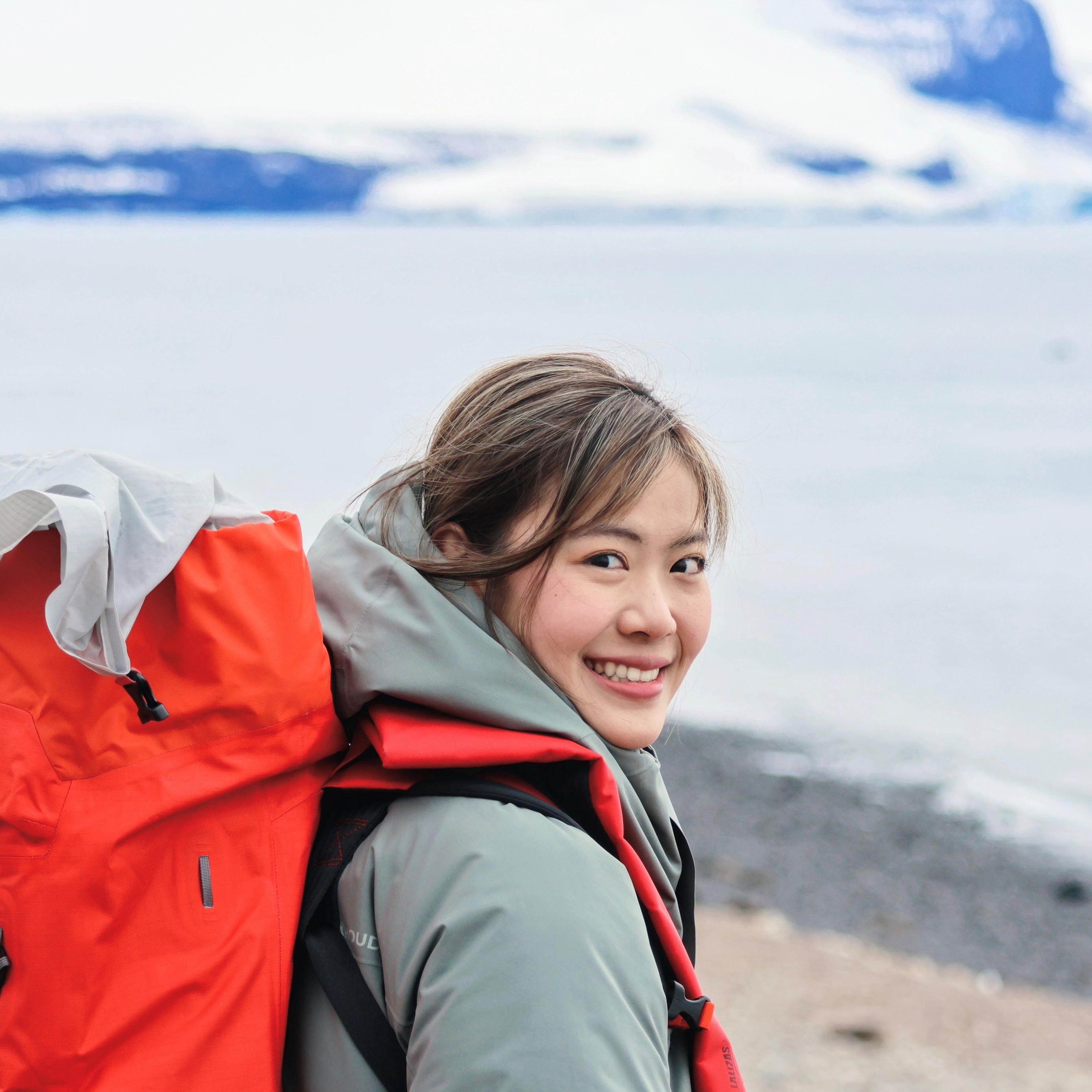
Climate Researcher and Advocate
Natalie Sum Yue Chung is a leading climate researcher and entrepreneur currently pursuing a PhD in Climate Change Policy at Princeton University, named one of the most impactful sustainability leaders in the Asia Pacific by The Japan Times and Eco-Business. She was selected as the sole Hong Kong representative at the Dr Sylvia Earle Antarctic Climate Expedition to champion ocean-climate solutions, subsequently named the inaugural Museum of Climate Change Scholar. Natalie serves as the Deputy Convenor for Youth and Capacity Building at the Hong Kong SAR Government Council for Carbon Neutrality and Sustainable Development, member at the Green Tech Fund Assessment Committee and the Country and Marine Parks Board. Driven by her passion for providing transformative nature-based experiences, Natalie co-founded V’air Sustainability Education, a pioneering climate education startup with presence at UN conferences including UNFCCC COP29, COP30 and IGF.