Annie (00:19)
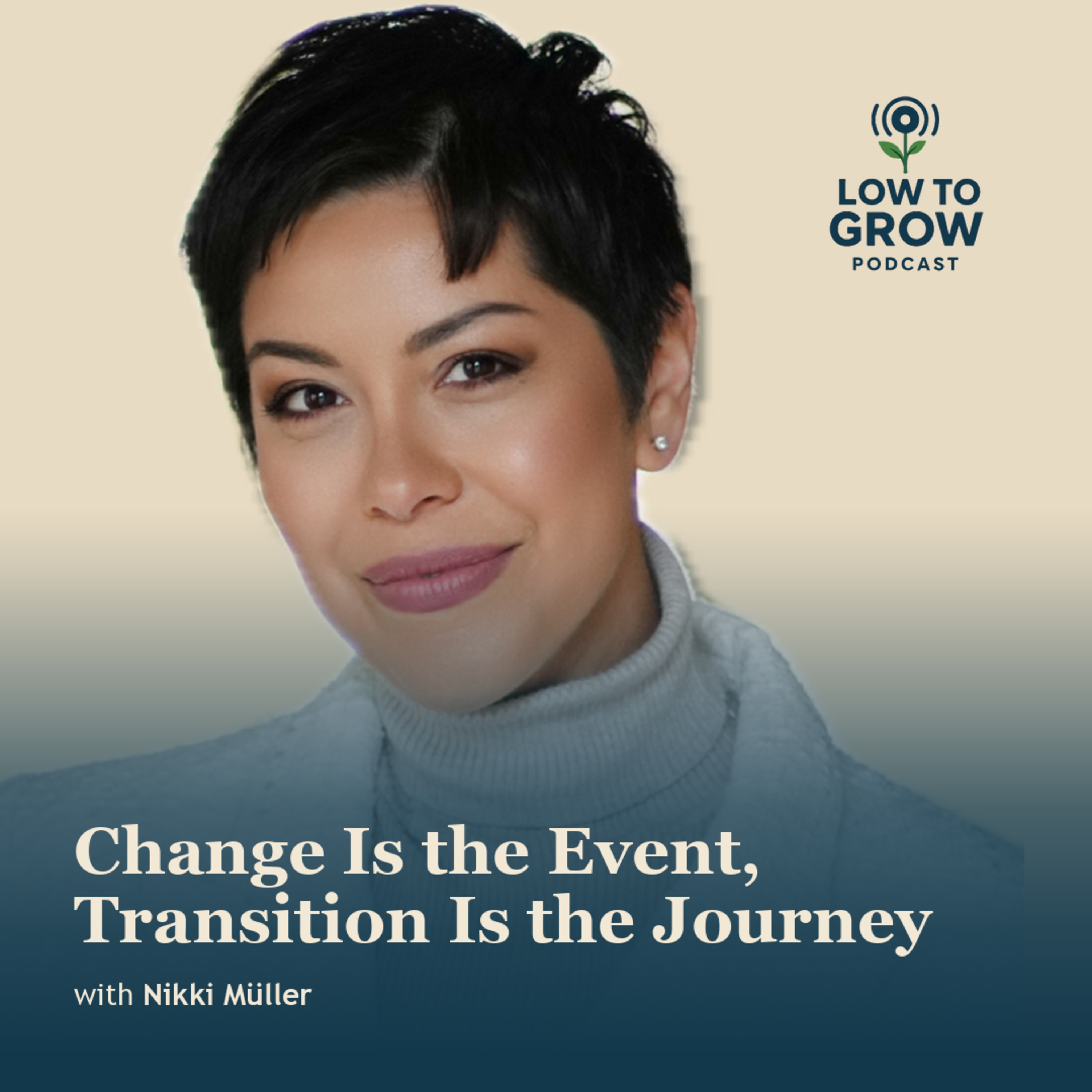
My guest today is Nikki Muller, presenter, keynote speaker, and life transitions authority. Her career reads like a series of leaps. MTV Asia at 15, a best entertainment presenter nomination for Disney Channel at 18, ABC News in New York at 21, Serving at the United Nations headquarters in New York.
And hosting more than 700 events across 26 countries. But why I invited Nikki to join me on Low to Grow isn't because of her impressive CV. Nikki is a Swiss-Filipino Third Culture Kid who grew up between countries and cultures, and she experienced disruption long before she had the language to properly explain it. That search for the language to explain her soul led her to delve into the psychology of life transitions.
And to co-create the Safe Passage podcast with clinical psychologist Dr. Doug Ota. And right now, Nikki is living her own biggest transition in real time, having left a 15-year career and community that she built for herself in Singapore for a new life back in her birth country, Switzerland. Nikki likes to say that change is the event, but transition is the journey. Now, Nikki is someone who hasn't just studied the map, but she has walked the entire terrain.
Annie Wenmiao Yu (01:36)
Nikki, welcome to the Low to Grow Podcast. I'm so excited to have you here. Who do you think will benefit the most from listening to our conversation today?
Nikki Müller (01:46)
I would say those who would benefit from our chat, it's basically anybody who's moving through a life transition and feeling uncertain and alone and kind of navigating through what is confusing and often unnamed territory. I think anybody who wants to move through the messy middle, which was my MO for pretty much most of my life, I would err on the side of caution because honestly, this this liminal space, which you and I know quite well, that in-between state is
It's it's messy, but it's essential. Okay, because the body keeps the score. And at the same time, this is really where the real opportunity for transformation can be cultivated. So if you're interested in that, if you've moved through change at some point in your life and we all have, this is the chat for you.
Annie Wenmiao Yu (02:34)
Wow, and the Body Keeps the Score, was that a reference to the book by Bessel Van Der Kolk?
Nikki Müller (02:38)
It is, and I think I've lived that enough times in my life to know. And of course, it's only in hindsight upon reflection that I noticed that my body was storing a lot of grief and unprocessed loss from a highly mobile cross-cultural childhood, not just from that, from other endings and chapters in my life where I felt like my world had ended over and over again. And if you don't give space and time, language and awareness to those moments and to allow those feelings to be felt.
To be recognized, to be seen, heard, and understood, then they will come out in physical ways, which it did for me.
Annie Wenmiao Yu (03:11)
where would you say that your story started?
Nikki Müller (03:15)
My story started funnily enough, I'm sitting here in Zurich, Switzerland. This is the place where I was born, but I was only here for two weeks. And then my parents moved around the world. And I think if you ask me where do I belong, I feel most at home where you are in England. Because those were my formative, my developmental years, even though it wasn't long because I was never anywhere long enough to really call a place home or to plant roots. It started here in Zurich, and when I turned 40,
I finally said, now is the time to reconcile a part of my identity that had eluded me for so long. And so I uprooted after 15 years in Singapore and I find myself here again. And it's a whole wonderful journey of self-discovery. so yeah, it starts here and it's where it's where I'm back now, which is amazing. But it took four decades. Slowly but surely I got there.
Annie Wenmiao Yu (04:03)
That's such a beautiful full circle moment and I'm really happy that we're able to have this conversation as you've gone back to Switzerland. But you know, for our audience who might not be aware, where did life take you in those forty years? Because I know we both share some time in Singapore, but what was it that took you away from Switzerland in the first place?
Nikki Müller (04:21)
One thing I'm starting to to learn and to understand was that this childhood was a great gift and it was challenging. I think TCKs, Third Culture Kids, the more you start to learn about this upbringing and all the very marketable gifts that it has given you, you have to accept the polarity of life because life is both color and shadow.
It is a gifted upbringing, and it was, and it was very challenging. It took me a long time to really acknowledge that. And a lot of Third Culture Kids do feel shame around that because they think, gosh, we have this wonderful life. Why would we ever discuss some of the losses and the hard times, right?
I started thinking about control. as a child, you don't control where you go and when you go, you go when your parents tell you to go. And when that's done enough times and you haven't had the permission to grieve and the time to grieve and to acknowledge the world that has ended before you get to take on a whole new identity and new community, that becomes extremely difficult.
And so Singapore was a huge deal for me because that was the first time or maybe the second time where I said, I am going to make a life because I believe it's correct for me. I'm going to make the decisions that work for me. I'm going to go down a career path that feels right. And I'm not going to move unless I know it's the right thing to do, not because it's the only thing I know how to do. And all of these things were just through understanding the way we grew up, right? Is that that sense of you you move because you were told.
And there were some wonderful experiences that come with that, but also a lot of losses. and I will say 2020 was a pivotal moment. If you if we were talking about low to grow, low to grow is 2020, and I think the whole world was given an opportunity. I think everyone experienced COVID and the pandemic in different ways because you're forced to reflect. Time stands still. I've been operating on high octane my whole life.
that is one of the coping mechanisms of being so highly mobile, is you have to adapt quickly. And yes, it gives you resilience and you learn to deal under pressure and learn how to deal with uncertainty. But 2020 was a time where I started listening. I said, something doesn't feel right. I have built a career that I am so proud of in presenting, be it in television or be it in conferences and and and stage presenting, etc.
A wonderful network of people. And yet I always wondered is there something waiting in the wings of my life waiting to make its entrance? I knew the answer was yes. And that's what took me down on this journey because all of a sudden you have the pause, you have the space to reflect. When you're moving on high octane and you're so close to a picture, you can't see it. So you need to give that distance. And that is one of the greatest gifts of COVID. But it was also a very low moment of almost identity crisis that was coupled with the research of.
How did I grow up? The whole themes of belonging and identity and uncertainty and grief and loss. And most importantly, transitions and therefore unsupported transitions, right? When you feel like you had to figure it all out by yourself because no one was talking about the hard bits, people don't like talking about the hard bits. We like to be forward thinking and future thinking. But at the same time, our patterns in adulthood, they default back to the ways of the past. And so if something or or was
modeled for you, whether it's healthy or unhealthy, with how we deal with new conditions and change, chances are that's going to prevail in adulthood. So COVID was this beautiful moment of I know I'm meant to be doing something else. What is that? And that took years of unpacking, of research, of finding new communities, often many of them online, to to take me to where I am today.
Annie Wenmiao Yu (07:56)
Hmm, I see. what was it that took you to so many countries before you turned eighteen?
Nikki Müller (08:01)
Hmm. Parents. Parents made decisions to move. Now, historically, of course, Third Culture Kids were children of missionaries or teachers or diplomats, military personnel, et cetera. eventually those were expats, and now, of course, we live in a world where it's certainly more commonplace, and you don't necessarily need to be given a posting. People just want to live somewhere else and try something new. But my parents were always quite adventurous.
so I went where they went and it did take me across continents. Some some countries I lived in twice, several I've lived in twice, so a lot of boomerangs and and and back and forth.
Annie Wenmiao Yu (08:33)
I love that. you mentioned that 2020 was a time that you and the world were forced to really sit still and reflect. earlier you mentioned that sometimes always being in motion, always taking action, that could be a coping mechanism that a lot of TCKs have. And upon reflection, that's something that I also have myself. I'm very much action-driven. And in my career, that generally serves me well. But I have noticed in the past few years that
Nikki Müller (08:39)
Mm.
Mm-hmm.
Annie Wenmiao Yu (08:59)
You know, I decided to wonder why it is it that I feel uncomfortable if I don't take take action straight away on something.
Nikki Müller (09:05)
Mm, this restlessness
is pervasive in in people who grew up this way.
Annie Wenmiao Yu (09:09)
Yes. So from your experience then, why do you think that is?
Nikki Müller (09:13)
I think subconsciously we were living in fight or flight for a very long time because the ground beneath you could shift at any given moment. And sometimes your parents might tell you, if they do it healthily, they might tell you a year in advance or six months. Sometimes they'll tell you once it's already happened, which did happen with me. I was living in England for seven years.
Went for a summer holiday in the Philippines as I used to do, and my parents sat me down and said, Actually, you're staying here. You're gonna begin high school, another formative time of your life as an adolescent, in the Philippines. So I never had a chance to say goodbye to my friends, to my room, any of that. it's also about
The tightening and loosening of affectional bonds. How close can I get to an individual? How invested can I be in this community and in this space and in this life if I know that at any point, sometimes with notice and sometimes without, it can be taken away.
Annie Wenmiao Yu (10:06)
Wow. Being told that you're just staying in a place without prior notice, and also around high school as well, that's quite a transformative and important age for someone.
Nikki Müller (10:14)
Yes, but it took
me a long time to actually look back on that. That's what 2020 allowed. And that had happened many years ago, right? It's what were the repercussions of not being able to say goodbye? Because one thing we learn in and there's a great co- course called The Laws of Transitions. So it's a wonderful organization that I started getting actively involved with through COVID, Safe Passage Across Networks, is there's this wonderful community there that actually helps students and teachers as well as parents.
Through mobility, right? Because they're going through rapid change, very, very quickly and quick succession. It's like a revolving door at some of these schools. And and positive transition scare is really acknowledging the ending, which we tend to not give enough time for because nobody likes endings. Nobody likes a funeral. But to be honest, when you lose your world, it is a death of sorts. So, and it's okay that you can grieve for it later on. If you don't do it now, it's okay the way I did. It took me 20 years, but I did it. And that
That has been very, very powerful. And we can apply that in all parts of our life, not just in our personal life, certainly in our professional lives, because we are getting hit thick, fast, and heavy with copious change, which means we are letting go of old ways, old identities, and old roles all the time. But how many organizations and leaders are really sensing that? Do we know the difference between change and transition? Because they're two different things. And all of that interest came as a result of this initial deep dive into the way you and I grew up.
Annie Wenmiao Yu (11:36)
Mm, I see. And I know that, you know, transitions, that's a very core part of your work now. Could you tell me a bit more about what the journey has been in building that? And also how that journey has transformed you from when you first started reflecting back in twenty twenty?
Nikki Müller (11:53)
Sure. So 2020 was important because how did I cope with that almost identity crisis, right? Of what should I do next? And what is this sort of feeling of a dark passenger that has followed me my whole life, but I can't quite name it or see it? and so I did what I usually do as a coping mechanism. I I leave I leave the country, even if it's just for a few weeks or a few months. I'm just gonna go and change scenery. But really, that's called just doing a geographic. When we try to solve.
An internal, I wouldn't call it a problem, but when we try to address the internal by applying it externally, that's just a geographic. It's just your area code that changes, but life is the same. And I went to a fitness camp in Thailand. And I did the same thing 10 years prior when I quit my job at the United Nations headquarters in New York City, when I also thought there was something going on, but couldn't quite figure out, and I knew I needed to do something else professionally. And when I went to this camp,
Apart from wanting to focus on myself in terms of nutrition and intense exercise, I found that every single person attending this fitness camp, and I guarantee you, if you went to any one of them right here, right now today, every person was going through transition. Something in their life was either destabilizing or warranted further insight or distance or reflection.
And funny that that was my subconscious, right? Yes, I will move because that's what TCKs do when they're restless and they can't figure out an answer now. Let me at least get on a plane. That's how I know how to do it, and I know how to do that well. But where did I choose to go? I chose to go to a hub and a community of people who were feeling something similar with very different lives, very different perspectives, and very different transitions. But they were losing something. Something was ending, something new was waiting in the wings.
But they in that moment were in transition. So I started at the same time, I was reading the same book you're reading now: Third Culture Kids Growing Up Among Worlds, David Pollock and Ruth Van Reken. And I went, how interesting is this? I'm starting to reconcile the losses I never had a chance to fully acknowledge as a child and therefore have carried with me as an adult. And what does this have to do with my career moving forward? That took five years, Annie.
I said, okay, maybe I'll talk about Third Culture Kids. And I did because it helped me and it helped me build a community and connect with other people who had similar lived experiences. That's what third culture is, right? Because we find our sense of belonging in people rather than places, people with shared experiences. and then I realized actually, this has a lot to do with what I've been seeing in the past 10 years and now past 15 years, because there I am on stage.
And I am this beautiful kind of like fly in the wall. When I say beautiful, it's a beautiful moment to watch decisions being made by massive leaders across industries. And many of them weren't at all thinking about the human impact of this change. We just expect because it's coming at us from all angles. And I thought these are transitions, these are human experiences that aren't being acknowledged. If you want someone to adopt a new practice, a new perspective, a new way of life, a new role.
They have to leave something behind, and no one looks at what they've left behind. And part of this positive transitions care framework is you have to say a proper goodbye in order to say a clear hello. That's what I mean by the neutral zone. This in-between stage is so important. That that's where the work is done. That's where transformation comes from. Really knowing what you're saying goodbye to.
knowing what you need to keep in order to make the change stick and successful, and most importantly, seeking support. Because I don't know about you, but for me, and I think a lot of Third Culture Kids did this prior to the awareness, was we just kept this all inside. If everyone else around us looked like they were fine, but they were also going through massive changes and they seemed to be coping, well then I guess I'll just go and say I'm fine too. And that really worked. It served me well. In fact,
I noticed that that kind of upbringing did influence the kinds of work that I did. As an entrepreneur and a freelancer, I want control of my time. I want autonomy of whom I work with. And do I want to work with them? That's why I keep the projects short. I can deliver high impact, high value, but I can get out. Because what if I don't want to work with you anymore? And I that has definitely got to do with that kind of upbringing.
Annie Wenmiao Yu (16:18)
how often do you think do people going through a transition actually realise that they are going through one?
Nikki Müller (16:25)
I think we have to start with really acknowledging the difference between change and transition. We use this word a lot and you hear it a lot in work speak, right? We're gonna transition now from this particular technology technology to another. So we really see it as quite a mechanical process, but it isn't. It's an internal process. Change is an event, and that's external. You can mark it on a calendar, right? This is when we implement the new policy, this is when we're moving countries.
Annie Wenmiao Yu (16:33)
Mm.
Nikki Müller (16:52)
this is when I'm getting married. That's the change. The transition takes a lot more time. That's the real journey and it's internal. So it's the human impact of change. And it takes longer than we'd like. It's more complicated. We'll go through something similar, like Elizabeth Kubler-Ross's famous five stages of grief, right? We might vacillate. one day we might feel like we've got the hang of it, and then the next day we'll feel like we've, you know.
We've gone right back to the start, feeling confused and anxious again. So I think most people don't really sit and think about transitions. Also, one, because we don't talk about it. It's not as pervasive as a change conversation is. We know what the change is. The transition, no one talks about it because it's emotional. And it's hard to talk about feelings, especially if it's never been modeled growing up. If no one around you was talking about feelings, whether they were difficult, challenging, or
or joyous feelings, then why would you in real life? And why would you in your personal life, in your professional life, right? So I think most people don't really sit back and go, how many transitions am I actually experiencing today? Because chances are it's not just one, it's four, it's five, right? At the same time, and they're not linear.
Which is incredible. And I think this was really validated recently. I took a course with MIT with an amazing professor, Dr. Hal Gregorson. And his course was about navigating transitions through disruptive AI. And I knew that he was going to focus on the internal journey and not about the tech. The majority was that. It was really about managing emotional energy.
And there were CIOs and all these leaders and talent managers who were trying to figure out how do I get people on board. And they were shocked that the curriculum was dealing with this. And I went, just sort of giggling to myself, going, Great, this is my research. It's proving a point. This is what organizations need, and that's what human beings need. By day two, people started talking about what was really brewing underneath the surface. It wasn't about AI adoption or resistance to it, it was actually.
My mom's just died. My wife has lost her job and I'm not sure what to do next. Three, if I'm not doing this role, what is my value at the workplace? There were all of these other transitions that were very personal, that were about identity, that no one was talking about, and they certainly aren't going to be talking about it in the workplace. And that is underneath of all the change that we ask people to do. So this is why I know this is important work because.
Every change, if it's gonna stick, has to really be supporting the individuals through it. And that is through language and awareness of what transition looks and feels like, and to acknowledge that there is gonna be a state of we're not yet at the new place, but the trains already lost left the station. And that's when we need to talk about it, especially feelings, which most people don't want to do.
Annie Wenmiao Yu (19:47)
How would someone start talking to a loved one, a friend, a family member about how they're feeling about an upcoming change and their experience of that transition if the person they're trying to get to really is a bit more closed off in that sense?
Nikki Müller (19:56)
Hm.
Yes, of course. There are there are. I mean, it could be you could open up a conversation with saying, well, you know, something big i is coming up. what's top of mind for you regarding this upcoming change or this transition? So it's kind of an open ended question. And chances are people will start with something quite prosaic and high level.
And then I think it's really about how how well you listen, right? How well we get deep into what does this actually mean for the human being? What are they really saying? So eventually we should get good at naming the feeling that we're feeling. Dan Siegel right when he said that whole theory of name it to tame it. So if you accurately name the emotion you're experiencing, you reduce the intensity by 50%. You don't have to fix things. It's not about fixing, it's about acknowledging that it exists.
Because that's the validation we look for to feel seen, heard, and understood. Right. So there are different ways. There's different ways in the workplace in which we could talk about it, The last time we did something hard, right? When people sometimes when it's a huge organizational change and they'll say, I don't know if I can get on board with this. It sounds too ambitious. And I think a good leader would say, Here's the last time we did something, and I'll let you into a secret. I didn't think we could do it. It was too much. And we actually did.
And so you remind someone of the last time they did a hard thing and moved through it. And sometimes that's a way in which you can just acknowledge that, you know, some people just want to be acknowledged that this isn't easy. We keep expecting and expecting people to get on board with whatever change it is because we think it's good. And it probably is, but it won't stick and it won't last if if people aren't along with you and they will be with you if they feel like they've got your support, right? Together we can do hard things.
Right. I mean, out of John Hopkins, there's some wonderful research that shows that if you see a steep hill and you're standing with your friend and you've got a backpack on, you kind of estimate that that hill is less steep because you've got someone by your side versus if you were there on your own or with someone you didn't really know.
Annie Wenmiao Yu (22:09)
I really love
that imagery of standing with your friend and actually you know when you're when you have someone behind your back or next to you, every challenge that you're looking on actually looks a bit smaller. And this links to a question that I really wanted to ask you, Nikki, because you traverse and you connect multiple geographies and also communities in what you do and also I guess versions of people, you know, clients with who they are and who they could become. what is
Nikki Müller (22:12)
Yes.
Yeah.
Annie Wenmiao Yu (22:34)
Your sense of who your community is. And every time that you move to a new place, how do you go about finding your community?
Nikki Müller (22:45)
I grossly underestimated the need for community in my recent transition to Switzerland. Funnily enough, after you read that book and you learn about rafting, kind of the process of when you leave a place, reconciliation, you make amends with people that you have unfinished business with, affirmation, you tell the people that have meant something to you that they have and why. Farewell, you really
Create a moment or a ritual to acknowledge that chapter is ending and then think destination T. Then you start really planning the logistics of what you will do. And I had prepared for all of that, considering all the research I'd done on how to leave well and grieve well so I can begin a new life. And yet, this transition hit me like a ton of bricks. It was the toughest of my life. And I thought, 40 years of moving and this is the hard one? Why? And I think it's as we get older the stakes are higher.
And also I realize now more than ever how we need community. And yes, I had people here, Annie, people who were waiting for me to call them who kept texting me going, Hey, you moved to Zurich. This is exciting. When do we meet up? What do we do? And I said, I need to, I need to solve this by myself because it's bringing up more things from the past that I thought I had already dealt with in the past five years. But of course, transition stress is real.
You can't think, you can't think strategically, you can't be creative. I suffered from executive dysfunction. I couldn't read. I couldn't, I couldn't drive the car properly. I couldn't understand why after doing everything so well. And funnily enough, my therapist said it's because I did it so well. If your whole life is the overcompensator, over protector in you is at the wheel, and now you've told that identity.
That I no longer need you because I've actually acknowledged all the things I never did in the past. Then what's left is the real you and the real losses that you have not actually acknowledged yet. So it took me a long time. But here's what the saving grace. I didn't isolate myself completely. In fact, I started a podcast with an incredible psychologist and transitions expert, Dr. Doug Oda.
And I told him, I can't do this podcast about life transitions whilst I'm in the middle of a really crazy transition. And he said, now's the perfect time. I thought I should reflect in hindsight, come up with all the great insights and lessons learned, and then apply it and have a conversation on camera and behind a mic. I said, Okay, I'm gonna be extremely vulnerable here and I'm gonna do it every Thursday for the first six to seven months that I was here. so he was my support system.
And I was part of that organization, Safe Passage Across Networks. And so I may not have physically gone out to make friends here, which I'm doing now. but I always sought community regardless, even when I didn't want to. And that's what happens in transition. We will want to isolate when we need community and support the most, is when actually we want to isolate, because it's confusing. We don't know what we're feeling.
Who wants to tell a colleague that I don't know what's going on? Who wants to tell their partner who has so many things going on in their life that something is wrong and I need help? TCKs, I believe, have a very difficult time asking for help because it was never offered. And two, they survived just fine without it, but only up until a point.
Annie Wenmiao Yu (26:03)
I can think of so many examples from what I've seen around me of when that has happened,
Nikki Müller (26:08)
And about for you?
I mean, it seems, it seems we are so similar in the sense that we're go-getters, we get things done, we want to move quick, we don't have a lot of time for fluff and faff. but in terms of community and and how you keep yourself grounded when the ground is shifting, how did how did you navigate that?
Annie Wenmiao Yu (26:28)
reading was always my way to ground myself and also if I'm upset, if I'm angry, I know that as soon as I open a book and I read a few pages, I will calm down immediately. And now knowing what I do, that's actually a very common self-soothing or self-regulation mechanism especially for children who didn't have siblings or other sources of support around them.
Nikki Müller (26:30)
Mm.
Are you an
only child too? there we go. Double layer of complexity as well, of being self-sufficient, independent, and resourceful, right?
Annie Wenmiao Yu (26:51)
I am only a child too, are you? We are.
that's so true. And I think a lot of it, as you were mentioning earlier, is also learned behaviour from what I saw in the adults around me. So my parents, they are both incredible people. But you know, every time that we moved to a new country, there was no one that they could really go to to ask for help. So they had to figure things out themselves. And I think the good thing that gave me was this kind of endless curiosity to problem solve by myself, which really led to why I wanted to do chemistry at university. It was all about science problem solving.
Nikki Müller (27:17)
Mm.
Yes. Mm.
Annie Wenmiao Yu (27:28)
And then after university to entrepreneurship where it's just one big problem that you're solving on a day-to-day basis. But I think, you know, when you were asking about when that breakdown happened to me, I think the biggest change that I saw in how I viewed myself and how the world would have seen me is actually in my last year of university, as I was finishing a degree and all of my friends, mostly go into management consultancy, finance or law, no matter what they studied. And
Nikki Müller (27:32)
Yes.
Annie Wenmiao Yu (27:55)
Back when I started my company, no one was really looking into entrepreneurship in the UK anyway. There's a lot of good success stories in the US about tech entrepreneurs from university, but not so much in the UK back in 2019. But I just kind of, throughout the last year of my university, had this repeating mantra in my head, which was when I finish university, no one else is going to dictate how I spend my time. And for some reason, that was so important to me, and which is why I also related to what you were saying earlier about.
Nikki Müller (28:00)
Hmm.
Annie Wenmiao Yu (28:22)
Wanting to have autonomy as an entrepreneur. And I think that decision to not follow a laid out path was something that no one in my family could have predicted, and they were quite surprised by that. but it's something that I believed in and that I felt that I needed in order to feel happy, strong enough to really pursue it and to carry it through.
Nikki Müller (28:35)
Mm.
And I'm glad you listened.
I'm really glad you listened because many of us are afraid to explore that, right? I mean, it also risks, right? TCKs take a lot of risks, I think. We're not afraid of risk. We're not afraid of uncertainty. We're not afraid of change, because we've dealt with it many times. One thing I will say about the restlessness you mentioned earlier is something that TCK therapist had said in a podcast. She said, for most people, their work is.
Moving closer to the danger zone and getting out of their comfort zone in order for growth to appear. For us, where disruption was your baseline, the intensity of that free fall of what's happening? What what do I have to adjust here? What does my world look like now? What is being required of me? All of that confluence at once meant that disruption was our baseline. So I found
Myself looking back at the types of work that I chose, sure, one was freelance and one was being able to work on projects that I liked. But I took on projects that were so high adrenaline and so fight or flight, like live television, was working with Fox Sports, I was wearing so many hats, which is still a problem today. You know. Yes, was like, my brain is everywhere. wearing so I said if basically
Annie Wenmiao Yu (29:50)
Even today, as you're saying, you're still balancing so much.
Nikki Müller (29:57)
If the work didn't feel dangerous, it didn't feel meaningful. And this is also one of the reasons why I felt I atrophied at my only full-time job with actual health care and benefits and pension at the United Nations. I said, Well, Jesus, if everything's just stable here, well, where's the fun in that? Give me action, give me danger any day. So it was really sort of befriending the nervous system in a way that is healthy and also saying, okay, our work is different.
Sometimes we have to lean in to baseline, quiet. Nothing's changing, and that's okay. Right? Which, which is probably why the last move was so tough, because I had done all that work that I came here, and there wasn't anything for me to do and to frantically panic about, because I had said my goodbyes. And that was the panic: was, well, everything is fine. I don't know how to stay still.
And that was the overwhelm. yeah. So our work is different in the sense where but it's again, it's really marketable gifts, right? Like you said, the cre being able to think outside the box creatively, be able to understand other people's perspectives, to be able to lean in with curiosity. because you've processed so much data in so many ways your whole life. It's been multi-sensory for you,
Annie Wenmiao Yu (31:14)
I always see TCKs a sponge. And whatever environment you drop them into, they just soak up everything and they're able to still be strong and present well, outwardly anyway, maybe not so much on the inside. but you know, going back to what you were saying earlier about how with TCKs we're so used to having constant change that we find situations or environments boring if we don't have that.
Nikki Müller (31:17)
Yeah.
Outwardly, yeah. Yeah.
Hmm.
Annie Wenmiao Yu (31:38)
So for me, I kind of so A, hold my hand up, that's me for sure. I've become aware of it over the past few years. I'm not sure if I have quite solved it. But then I'm also wondering maybe it's not a problem to be solved. Maybe I just need to be more aware of it and consciously then maybe sort of like assign points in my life so that I can lean in more towards the chaos at some points and then give myself breaks to really reset as well.
Nikki Müller (31:51)
Mm mm Yes.
Annie Wenmiao Yu (32:06)
What are your thoughts on that? closing the loop move back to Switzerland and you're also having a pivot in your career and really exploring the transitional phases. What are your thoughts on that?
Nikki Müller (32:09)
Yeah.
Mm, mm.
You know how many Third Culture Kids grapple with massive themes like belonging and identity, meaning you like you said, we can pick up a lot of great skills and ideas and cultural references from the many places we've lived, but we also don't have full ownership of any, right? And it's what's interesting in the research is that it's usually in our mid thirties that we have the aha moment and epiphany.
And I asked Ruth Van Rieken, what is it about the 30s? Why? And she goes, I don't know. It just so happened that everybody I talked to, I said, I could guarantee you they were in their 30s. And they were. And I think it has a lot to do with developmental transition, right? So these are sort of thresholds and milestones in our life. Our first developmental transition was adolescence.
That's when we were really developing our own identity, our own ideas and values outside of what was modeled and designed for us by our attachment figures and our parents and our teachers, et cetera. And they called that rebellion. It was not rebellion. We were figuring out who we were. And then it happens again around midlife. So and so for Third Culture Kids, it's kind of early midlife. when we when we sit with a lot of the things that were never named, were never given time for.
Annie Wenmiao Yu (33:24)
Hmm.
Nikki Müller (33:31)
And so for me, I realize now my sense of belonging is always going to be with people of similar experiences. my identity is going to be a confluence for life, and I'm also okay with that. But what was very important for me with this move to Switzerland was that on paper, it sounds like I was trying to find myself that I would get all the answers of that part of my identity because I'm Swiss Filipino and I spent a lot of time in the Philippines and not in Switzerland.
I realized I needed to really be a bit more compassionate in terms of expectations, that it would take longer for me to feel really connected to the people and to the land. Just because the passport matches does not mean I feel this way. I also look more Asian than I do Swiss. I think that's the hard part for me is the compounded complexity or the added layer of complexity of being mixed race. Because
I sometimes feel like I don't belong within my own family. I'm the only one who looks like this. And so I have noticed growing up that I'm also treated differently. I'm the only one who lived this way, the way you and I have lived. So I know that I'm here in Switzerland, and though my passport matches, I'm I'm I don't understand all the vernacular. I don't watch all the local TV shows, which is actually what happens and for a lot of TCKs. Now you may go to a country and you look just like them.
But you feel very different on the inside. And that's a hidden immigrant experience, right? Because you look like everybody else, but actually you're not keeping up. You don't know what's going on. And then they wonder, well, how come she's how come she didn't get what I said? What's wrong with that person? Right. So, but now that we have the awareness and the language for these feelings and and and experiences, I think it's more just the most important word in the language is and it's a beautiful, enriching life, and it's challenging.
And if we can live with that duality and give space and acknowledge that this is what makes us us, rather than having to solve it or to put ourselves in a box. You will never be able to put yourself in a box. And we love putting people in boxes. once we really, you know, that whole curiosity, well, what does this give me? What what more does this give me than perhaps some others don't? And it's really incredible. But we have to acknowledge both the light and the dark.
And for so many years we have we embraced how amazing this was, how great it was, the gifted opportunity, how not so many people don't have this chance. What a blessing. And all of that is correct. But then when we focus too much on a positive future, we invalidate our real experience. And that's that's why in our 30s we say the buck stops here. There's more to what I was told.
There was more to what I lived and acknowledged. And now it's time for me to to give it space and room because it is just a big a part of me, as big a part of me as all the wonderful positive parts of my life.
Annie Wenmiao Yu (36:25)
Mm. I think what you've described is the point when a person really embraces every single part of them and they're not ashamed of the negative feelings that they had felt before, but they're really owning it. And by owning those negative feelings, are they actually truly accepting themselves? And what I love about what you did earlier was how you really emphasized that it's okay to have a mentality of the "and" mentality. Because I think growing up, having lived in Singapore and having l lived in the UK.
Nikki Müller (36:41)
Hmm.
Hmm.
Annie Wenmiao Yu (36:53)
There are sometimes very opposing customs to the same thing. for example, in and also in many East Asian cultures, when you eat, you're meant to hold the bowl and you can put your elbows on the table. But in the UK, that's definitely not something that you would do. So what might seem very odd or even rude in one culture might not be so in another culture. And I feel like I personally grow up just accepting that these both can coexist.
Nikki Müller (36:56)
Yes.
Annie Wenmiao Yu (37:20)
even if if they seem quite contradictory. and I think one thing that I noticed was perhaps friends or people that I met in my youth, they probably might see me accept multiple things and think that, maybe Annie just doesn't really know her mind or she can't make judgments. And I used to be really hurt by that. But then recently I realized well actually this is a trait that a lot of TCKs have. And actually I think this is a good trait for
Nikki Müller (37:36)
Mm.
Annie Wenmiao Yu (37:46)
empathy and also being able to have a truly global view. so that's why I was really happy that you kind of mentioned that this "and", and accepting multiple versions of truth is so important.
Nikki Müller (37:54)
Yes, but
Yeah, because and that's why they say Third Culture Kids are bridge builders. That's that's the gift. We can we can hold space for opposing views and allow each of them to feel sir seen and respected. Which is why I think for change management, Third Culture Kids are are primed. They're primed for being able to be empathic and understanding because we've had to live in in situations and in places with many people who don't think the way we do.
And and so we develop the space for that, right? but of course, there's also the self-editing. I don't know if you've noticed that because but you you kind of made me think about that when we were talking about the bowl. Because I I know someone who grew up as a Third Culture Kid. I went to high school with him in the Philippines, and only many years later in Singapore, I met him and he told me of almost a almost like a psychological breakdown that he went through when he was in Canada.
And he it was only a therapist who said, it's because you are exhausted with all the edits that you don't know which part of you is real anymore. Because we will tailor our responses, our actions, our accents, our language, our ideas, our opinions, depending on whether or not that's palatable to the person in front of us. We know how to do that really well, which is actually the problem with us being chameleons and sponges.
Annie Wenmiao Yu (39:02)
Mm.
Nikki Müller (39:20)
Is that we start to lose who we are because we're so good at adjusting for the person or the the group in front of us that our we start to lose the essence of who what we actually believe in who we are. And that's what what he went through was he was just so exhausted from having to one conversation he he used some parts of the life his life, another conversation he brought up others, it became, you know, like multiple personality disorder.
It it it was too much. And he took a year off and he took a year off work and he did the work and he explored what this upbringing was like and said, Okay, yeah, this is why it's happening. And that's why the awareness is important. You don't necessarily change or fix anything, but the moment you recognize why and how something has happened or you're feeling this way, or why you adjust in certain situations, just knowing, oop, I'm tailoring my con my answer for you here.
I'm doing it. Just knowing that you're doing it is is again validating your own experience.
Annie Wenmiao Yu (40:25)
Hmm, that makes sense because being aware when you're doing something means that you're also taking ownership of having taken that action rather than feeling like it's life passing through you or passing by you. So yeah, thank you so much for raising that. Nikki, how did you feel in your say twenties when someone asked you, where are you from? And how do you feel now when someone asks you that? And what is your answer?
Nikki Müller (40:42)
Mm.
My answer is always the same. I don't answer it. I say I'm half Swiss, half Filipino, and I end it there. Also a TCK trait. Those who are curious will lean in and then I will give you more information about my highly mobile upbringing because now I know you genuinely care and are interested. But if you don't ask anymore, that means you really just wanted a straight answer, which most people do. Most people just want to know, hey, I'm from Wisconsin, hey, I'm from Tokyo. And then they want to move on to getting to know you, the human being.
But when you can't answer a simple question like where are you from or where is home? And you're just meeting someone, that creates a huge overwhelm. So my answer in my twenties is still the same as today. I will I I use my race, I use my ethnicity, my background, and then if you'd like to know more about where I've lived, because that's one of the things, right? For people like you and I.
It's a complicated question. Do you mean where my mom is from, where my dad was born, where I live now, where I used to live, and where or where I'm moving? It could be like five, six different things, right? For most people, they can answer very confidently where they're from because they have roots in a monoculture. They have identity anchors in a monoculture. Maybe it was several cities, but in a monoculture in one country. And when that changes during your developmental years, how on earth can you answer that question?
My parents used to say, home is wherever we are. I st I don't believe it. I still don't. When someone says, well, what feels like home? Singapore felt like home, which is why that was probably the hardest move for me. 15 years anywhere, by choice, that was the family I chose, not the family I was born with. I realize now why this was also hard for me to move to Switzerland was I knew the grief I would expect.
But you can't feel it and live it until it's there, meaning I had to leave the world behind. to your point earlier about support and community, I didn't realize how much people need people until it's all taken away. Even if it's by choice, transition is hard, whether we choose it or not, whether it's one that's made for us, a decision that's made for us, or a decision we make on our own. So home is always going to be that, ooh, loaded question. And I answer it that way.
And again, if people are curious, they can ask more. How about you? What do you say?
Annie Wenmiao Yu (43:09)
almost feel an existential crisis when people ask me that and I used to default to oversharing which is I tell them every single country that I've lived in. but then now I just say the most recent place where I live in which is now London. And if they are curious then they will normally ask a follow up and then I'm more than happy to share. Yeah.
Nikki Müller (43:25)
Yeah. Yes.
Right? When it's safe to do so. When we feel it is safe to do so, we will share more. Otherwise. And why is that? Because something in our past told us it's not always safe to do so. Right? Like you said, the oversharing. You say it's oversharing because someone or maybe several people were overwhelmed. But I also think that's one of the TCK qualities is that we go deep real fast and we connect.
Annie Wenmiao Yu (43:38)
Hm, that's so true.
Nikki Müller (43:53)
Authentically, very quickly. And I think part of that is because we don't know how long we have with you. So we're not interested in the, you know, just the sort of mundane conversations, especially because our sense of belonging is in people and not places. That's why we go deep real quick. This is why we overshare. And over time we were punished for it. And so we stop.
Annie Wenmiao Yu (44:17)
I've actually never thought about it that way. It's a way of preempting loss and it's a way of going deep so that you can maximize your, you know, connected time with this other human being before you're taken away again. Wow, Nikki, that's something that you've left me with that I will definitely be thinking about even more. let me end by asking you our podcast staple, which is what is one thing that you do for better mental health?
Nikki Müller (44:22)
You're right.
Yes.
I'm no longer afraid to be curious about my uncomfortable feelings. I believe that feelings are neither positive nor negative, they're simply information. I believe it's important to sit with it and to allow space with it, almost like inviting the feel the feeling to sit down and have a drink. Get cozy, get comfortable, and ask, what is this feeling trying to tell me? Because it is information. There is something going on.
That in our busy lives we don't always make room for. And our internal world is just as real as our external world. And some of us just don't like spending time there. And don't be afraid. Some people say, I don't want to go to the dark place. well, never try to do it alone. You can it and most people will want to, but talk about it with somebody that you trust, whether it's going to be a therapist, whether it's going to be a parent that you trust. yeah. Don't
Don't be afraid to listen to what your body is trying to tell you because when something is uncomfortable, it's also the best opportunity for real transformation. Something huge is waiting for you to acknowledge that it's there. But if you run away from that information, it's you do yourself a disservice because that means that some potential in the future might never be realized.
Annie Wenmiao Yu (45:59)
Thank you so much for sharing that, Nikki and also for talking about all your experiences so openly.
Nikki Müller (46:04)
Thank you for being curious and for asking. I feel so good. Thank you very much, Annie. You're doing wonderful work. Wonderful work. And you've got so many great people on this podcast. I'm learning a lot from listening to those conversations. And I'm I'm excited for your journey.
Annie Wenmiao Yu (46:09)
Fantastic.