Bayo Adelaja (00:00)
this client is being horrible and they're yelling And my response is, why would we take that? We have a contract, let's dump them. We don't have to take their money.
Annie Wenmiao Yu (00:20)
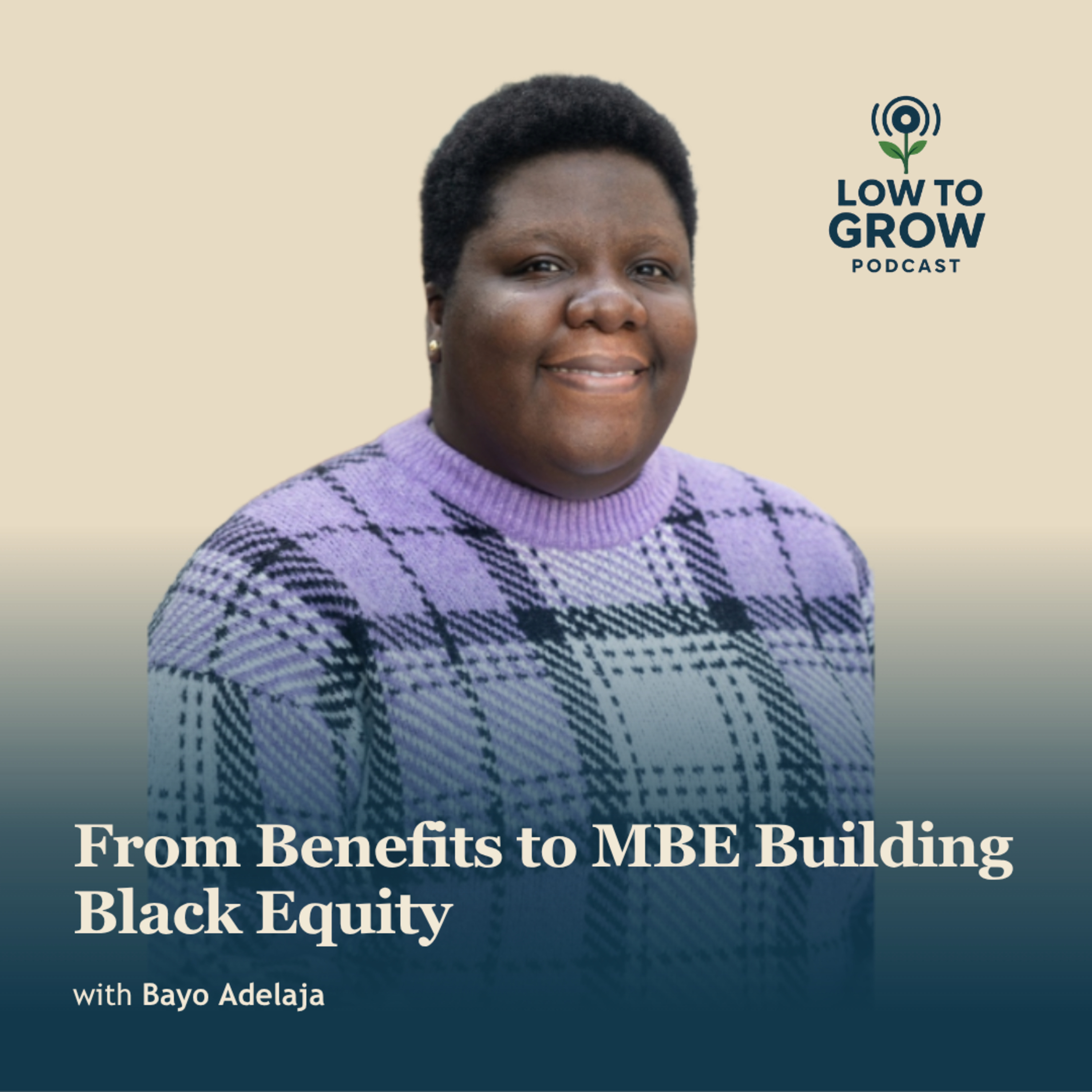
Today, I'm joined by someone whose presence feels both visionary and deeply grounded. Bayo Adelaja is the founder and chief executive of Do It Now, Now. It's a London-based organization that's reshaping equity and opportunity for Black communities across the UK. She holds two master's degrees from the London School of Economics and a degree from Durham University. And interestingly, she comes from a remarkable family of change makers.
Both of Bayo's grandfathers were honored by the late Queen for their contributions towards social service. And Bayo herself was awarded her own MBE in the King's 2024 New Year's Honours List for her contributions towards social mobility, financial inclusion, and entrepreneurship. Bayo is certainly carrying her grandfather's legacies forward with an incredible blend of intellect, purpose, and heart. And Bayo, I am really delighted to have you on Low to Grow today. Welcome.
Bayo Adelaja (01:17)
Thank you for having me, I'm glad to be here.
Annie Wenmiao Yu (01:20)
Wonderful. Bayo, who do you want to be listening to our conversation today?
Bayo Adelaja (01:27)
I do a lot of the work in my community for my community, or all of the work is for my community. So hopefully the person that's listening to this is someone that identifies with being othered in spaces that you feel like you have the qualifications for, the passion for, and the dedication to thrive in that space.
Annie Wenmiao Yu (01:49)
Bayo for you, where do you see your own story beginning?
Bayo Adelaja (01:55)
Well, the story of Do It Now, Now and my own story are not exactly, not particularly different. I set out to build something that felt very much like the mission that I have for my own life. So the creation of Do It Now, Now, at least at the very beginning, was a vehicle to create the world I want to live in and exist in a space that felt like I was doing something with my own life. So...
Despite the fact that I am actually 35, will say my life began 10 years ago. When I started It Now, Now, I was working in a research position at LSE. I was in the middle of my second master's there. And I just wanted to build something that allowed me to use all of the disparate experiences that I've had in my own life. The conversations I was having with friends who felt disempowered in the workplace, who felt like they were.
losing themselves in other people's visions and missions and ideas for what the world should be. And I started collecting those stories, collecting all of that data and put it together as a solution. In April of 2016, I brought all of my friends together in my living room and I said, hey, so all of these conversations we've been having, this is the vehicle to make it into an actual solution.
And I'm very grateful that I had friends who were willing to graft with me in the very beginning for a couple of years of free labour. They worked with me to make it happen.
Annie Wenmiao Yu (03:24)
you make it sound almost quite easy but I'm sure that it was quite a challenge getting something off the ground from just a mere idea that you had. How did you grow It Now, Now into what it is today?
Bayo Adelaja (03:37)
Well, today, It Now, Now is in 17 person team full time across the team. And going from 2016, I was working full time somewhere and was running It Now, Now as a voluntary project. So about half of my paycheck was going into It Now, Now every single month. And when I left LSE, because I was at the end of my master's programme, I was made redundant from that role.
in a company-wide shakeup of qualitative researches, which is what my discipline is. I then had the opportunity to take that redundancy check and then invest it properly and into It Now, Now. That didn't go so well because the middle of 2017, I'd completely run out of money and didn't have a job and therefore ended up on benefits. So I was on benefits, had to move out of my
wonderful little cute little studio apartment St John's Wood, just around the corner from Abbey Road Studios it was just like this dream of you bump into celebrities in Tesco. It was just like this thing that I'm so excited to be living this life and I was so proud of myself for having built a life that could let me achieve something like that, to being on benefits,
I worked at the Deliveroo call center to get extra money. I cleaned toilets and made pizzas, not at the same time, obviously, at a pizza place down the road from me and Baker Street. I did that for a couple of years as I was also then working freelance for a lot of different similar organizations, not for the black community specifically, or black and global majority community specifically.
But I started a kind of consulting career, ended up consulting for Google for startups, built their POC community and built their women's community, not built it from scratch, but it had kind of dipped and then they brought me in to rebuild and make it stronger. It took all of those lessons and turned that into something that was starting to bring in pretty sensible contracts from pretty
reasonably minded, well-funded entities, and then COVID hit. And I went from a good group of freelancers that were incredible at what they did to nobody again, and no money for what felt like forever. But in hindsight, it was only about four months of the bills coming in and no money to pay anything. And that led to, as we all know, the public murder of George Floyd. Not led to, it didn't cause it, certainly, but...
it coalesced, it happened all at the same time. And that really led to a lot of the things that I'd been dreaming of being able to do suddenly becoming possible and, using the, the experience and the kind of gravitas or cachet awards or whatever that I had amassed in that time of being horribly broke, but still thankfully presenting as doing well, was able to turn that into what is now.
the entity that it is today, where we've been able to in the span of a few years, give just over 3.5 million pounds to black led organizations across the UK. And we're going up, we're going to do another 2.5 million this coming year. And it's incredible to have had that personal journey of going from,
well to do kind of highly educated, on paper, the thing that everyone wanted me to be and then turning into turning into what it was as a freelancer then now hiring staff of my own. So it's been highly traumatic. I will say that it has been one of the, I don't think it should be this hard to do, to build a business. I think it is unfairly difficult.
to build what It Now, Now is.
Annie Wenmiao Yu (07:21)
Hmm, understood. From what you were describing, the loss of identities that you had. I actually wanted to delve a bit deeper into what you saying earlier about when you had to move out of your studio apartment where you were seeing celebrities in the local grocery shop to, having to live off benefits, and then really, really having to fight to get your own, I guess, portfolio career up and running again.
to now becoming a business owner that full-time employees depend on for their salaries each month. When you had just moved out of that studio and you were in that first month of having to survive on benefits, what was going through your mind at that time?
Bayo Adelaja (08:02)
Well, actually, the first thing I did is I went home. I and home for me is Nigeria. So I went to Nigeria and I thought that would allow the money to last longer. didn't, not really. But when I got back to UK, it was was harrowing, honestly. I mean, I'm not I'm not suggesting that I've never experienced hard times before that. I mean, we grew up my my family.
While my grandparents have this wonderful legacy financially it didn't quite trickle down over the generation. So we grew up quite financially insecure. so I knew what it was to be broke. I had known that I experienced bailiffs and things like that. So I was aware of that kind of what it was to live in that circumstance. I just
didn't think I would ever be back there. I had built my entire life from being a teenager to never be in that position again. the Durham LSE, two master's degrees at LSE. mean, all of the doing all of the things compulsively almost doing all of the things you're supposed to do in order to ensure that you do not end up in that position. And the redundancy came but I had already started building
It Now, Now, and I knew I wanted to leave. I just couldn't find the courage to actually. So the redundancy did actually kind of give me the push that I needed because it was like, well, this is the opportunity now you can either find another job that you know you're not going to be able to do the thing that you're actually deeply passionate about, or you can use this as an opportunity to build the thing. after a while, I'm highly competitive and also incredibly stubborn.
So after a while, my competitiveness and stubbornness kind of kicked in as my resilience. And that was what made me not quit no matter how difficult it was. Because yeah, it was going from that kind of studio to where I lived next was I lived in a house share for free that was just...
My, the room I was in was, I got it for free because it had been vacated by a sex worker in the middle of the night. And it wasn't one of those fancy sex workers. And it was one of the people that needs a room that cheap in order to be able to live. And sex work is the only option. And I got that room for free because that was what I had available to me. When you count down the...
rough the the beds you have before you end up rough sleeping. For me was the beds I had before I could I had to go back home with my tail between my legs and say fine I will get a job now. I'd say it was traumatic, I'd say it was hard but it was also my own doing. I decided over and over again stubbornly, pridefully, competitively, irritably.
that no one could tell me I couldn't do this thing that I wanted to do. And I repeatedly put myself in dangerous situations that it shouldn't have been in because I wanted to do this particular thing and ended up building really because of the public murder of a human being, the thing. Because if that didn't happen, the world would have reset and I would be working somewhere in a job.
that I probably qualified for, but deeply unhappy in. I ruminate on that reality constantly, truly, that the world doesn't create opportunities for you to live the thing that you want to live that often. And the fact that it was COVID, it was George Floyd, it was Ahmaud Arbery, it was Breonna Taylor, it was
the data and the reality coming out about key workers and immigrants and people who are unmapped in the system, dealing with the realities of COVID that made it obvious for people finally that the thing that I've been talking about for years at that point was necessary. So now kind of the fact that I'm thankfully back in a position where I'm financially stable,
I do my best to remind myself of everything that it costs to get here. Not me, but the system elements of it, the infrastructure elements of it, the world needing to be what it was in order for things like It Now, Now and other organizations that have become successful that do very similar things to us.
that only exist or only continue to exist today because of that particular notch in time.
Annie Wenmiao Yu (12:43)
Hmm. when you were in that financially unstable position, what was the motivation behind you working on focusing so almost single-mindedly on making Do It Now, Now into something that can really take off?
Bayo Adelaja (13:01)
The work we do specifically is about ensuring that people who are often humiliated, disenfranchised, disempowered have a voice and a place and are equipped and supported to be whoever it is they want to be. And someone that had to do a lot of work to figure out who I was.
While I recognize I come from an extreme privilege in a lot of different ways, I can't bear the idea that there is someone in the world
that can't be who they want to be to the fullest extent of themselves. And I just found myself for years before starting Do It Now, Now. I was so deeply unhappy. I had achieved all of these things and outwardly I was supposed to be the happiest I'd ever been. But I started almost every conversation with my friends for two years with the words, I hate my job. And it wasn't the job. just wasn't, I just knew I was supposed to be doing something.
And I was so, I still am so deeply passionate about equity and fairness and kindness and ensuring that people have what they need. And I know that I can't be everywhere and I can't, I certainly can't do everything. I'm never going to change a bed pan if I can help it. I'm not that person.
I volunteered for about a year talking to people on the street that were rough sleepers. It's not because I knew it was something that I wouldn't typically do. So I've made myself do it and that was an incredible experience. But I know that's not the thing I'm easiest at. The thing I'm easiest at is using my research skills, my analytical skills, my ability to speak relatively articulately about the mission and vision of our organization, finance, things like that. I can do those things.
And if those things mean that somewhere down the line, someone who was a rough sleeper gets a home, someone who came out incarceration gets a job, someone who is dealing with terrible mental health situations or domestic violence, whatever it might be, gets the support that they need because we were able to fund
a charity or a social enterprise that is creating a solution in that specific local area. Then that's incredible. And that is what, that is what I'm particularly passionate about.
Annie Wenmiao Yu (15:24)
And I think your passion is really coming across. And I read online that The Mayor of London, Sadiq Khan, actually praised your organization for the work that you do in uplifting black-led entrepreneurship and also the work that you do in really shining a huge spotlight on the various structural inequalities that do exist. From your perspective as the founder and the leader, what are some of the most pressing realities that black-led organizations still face today?
and how do you help them navigate those?
Bayo Adelaja (15:54)
There are so many different types of organizations that exist. It's such an incredibly broad spectrum. So you would think the problems would actually be broad as well, but they're rather singular. So across tech, charity, beauty, whatever it is that you find the layers of racism and
Annie Wenmiao Yu (16:02)
Mm-hmm.
Hmm.
Bayo Adelaja (16:16)
Well, everything else but racism is one I'll stick to. The layers of racism and the world as it exists when it comes to privilege and classism, you couldn't kind of boil everything down into access to funding, which is why we provide cash directly. The information age is such an interesting dilemma because yes, information is everywhere, but if you don't know the terms to Google,
or to put into chat GPT, whatever it is you use to search for things, it is highly unlikely that you will find exactly what you're looking for. implicit bias in the way people make decisions about who gets what, who is the face of what. One of my mom's favorite stories is,
I won a national essay competition when I was in year nine and they put the second person, the second place winner on the cover instead and he was a nice white boy and my mum is insistent that it was because I'm a black girl and it wasn't gonna be, they wouldn't like that on the cover of a paper, I have no idea, no one asked me for a picture. But it's things like that where there's just these assumptions as to what people want.
and how people want them, that stop you from being the face of something that you would like to be the face of, or stop you from getting the promotion that you would like to get. And that stops you from, in context of business, stops you from getting the investment because it's like, I don't think we could work together that well as the wealth holder or the bench capitalist and and the investee in the context of tech. Or, when it comes to foundations and trusts and who gets given the grant money, if you have to spend a lot of time explaining why the thing is important.
And someone else comes in and doesn't have to explain why it's important, but can only use the same word count to explain what they're going to do. The person that can use 400 words to say what they're going to do and the impact of it versus the person that spends 300 words explaining the black community to you and then talks about their work and the impact for 100 words is not going to get as far in the application process. So it's little things like that, the buildup that lead to
just an incredible amount of strain on the leaders of these entities who then have to do far more because our communities need far more with much less than their counterparts. An organization like Do It Now, Now, for the amount of work that we do, the amount of people that we support, we should be funded about three times the size that we are. But we know that there is a ceiling to how far we can go in our current model.
So we have to be creative about capacity, about planning, about resource management on the back end to ensure that we can work at the scale that we work while being a small organization to some of the national entities out there that serve beyond the black community. it's a catch 22 almost, but the challenges are singular in nature
with different fonts I suppose.
Annie Wenmiao Yu (19:13)
Bayo, for any of our listeners, these are people in their 20s or 30s and they might also be minorities either because of race, gender or experience in a group that they currently want to work in. For those of them who see themselves in your story of being in a minority background with some of the odds that against them, what are some words of encouragement or advice that you would give to them?
especially if they want to create and also maintain change in that particular organization.
Bayo Adelaja (19:44)
The first thing to decide is whether or not you are an intrapreneur or an entrepreneur. Are you someone that likes to make change within an entity? So you want to go in and lead something in an established institution and build from the inside out. I think those people are incredibly important. And those are the types of people that we work with quite often to get funding and support to outside entities.
Are you an entrepreneur? Are you someone that wants to build something completely from scratch because it doesn't exist or you think you could do it effectively differently? And you enjoy the creativity of building from scratch and you enjoy the pressure of building from scratch and the insecurity, lack of safety, all of the things that come with building from scratch because there is a romanticization that comes, or romanticism, that comes with entrepreneurship in the media as this thing.
that is glamorous, and there are glamorous elements of it. But for the most part, it's boring. And it's stressful. And a lot of people are relying on you as the final say on everything really. So if you enjoy that kind of dynamism, then yes, be an entrepreneur, and ensure that whatever you're doing, whether you're inside outside an institution, whether you're in government, whatever it is, ensure that the thing that you're doing
feels like you. Because one of the things that was actually the biggest kick up my backside while I was at employment, not for myself, mean, is that I read a research paper that said we spend 70 % of our lives at work or thinking about work. And then the next element was that
The majority of people that find themselves dealing with depression and anxiety in the workplace are doing so because they have a lack of autonomy in the workplace. So I realized that I needed to figure out where my autonomy was. when I realized in the structure that I was in, I couldn't experience autonomy in a way that made me feel comfortable because different people need different levels of autonomy to feel comfortable. So when I realized what my desired level of autonomy was, I realized I needed
to an entrepreneur in order to be myself in a workplace, in order to engage in a way that I feel most comfortable. find what level of power you are comfortable with. Find what level of what passion brings you, makes you alive and how you can make that factual as your day-to-day working experience and decide whether you want to be that person inside or an outsider in organization and what you are willing to give up in order to make that happen for yourself.
Annie Wenmiao Yu (22:30)
What you said there really resonated with me. think for me, it was also about choosing to be an entrepreneur because I realized that I have a strong desire for autonomy and also learning by doing and learning from my own mistakes when the time comes. But I think as I spent a few more years into entrepreneurship, I actually realized a lot of what I learned and what I really value entrepreneurship for is actually
learning to not outsource my own thinking and then to shoulder that responsibility for the actions that I choose, whether it's a good or bad outcome. I found that really liberating because I think up to then I had been a student myself and I also did a master's thesis and I just remembered feeling in a way stifled because I knew that there were certain parameters that I could operate in and I knew that there were certain structures that my work needed to fit in
in order to be accepted and validated. And that was something that I just, you know, spent a good year thinking about before fortunately having the opportunity to create my own company. So I think what you said there was super, super relevant. And whilst we were talking, I was also reflecting on your own journey from being made redundant to surviving on benefits to then receiving an MBE for your work with Do It Now, Now. When you first learned that you were going to be honored, what went through your mind?
Bayo Adelaja (23:47)
I'm not someone that celebrates things. I'm trying, 2026, that's the goal, celebrate more. so I tend to kind of need to run it by other people for them to help me understand what a big deal it is. when I told my mom and I told my brother, and my dad, they were the ones that kind of helped me understand how big a deal it was, because they were so excited.
because it wasn't rare in my circle. I know so many people that have had that honor and I thought, okay, it would be nice if it happened, but I'm not going to kind of bank on it. there were so many other things I want to do that I ended up kind of feeling like, yay, awesome, but okay, there's this like...
other bid that I need to write and there's this other thing that I need to do and we have this strategy that we're trying to deliver. But I was, so I didn't have like a moment of jubilation or whatever it is when I got the letter. I was kind of like, wow, cool. And moved on and then started telling my family and my colleagues at work and everyone who was so unbelievably excited. So I think I was more happy for them.
Annie Wenmiao Yu (24:39)
Okay.
Bayo Adelaja (25:01)
because they were so excited. So I was kind of like, yeah, you guys are happy. I don't know. It's a weird brain. mimicked to their happiness. I'm glad that I'm glad that we that I got the honor. But to me, I don't really see it as a personal honor, because it yes, it's honoring it in my name, but it's really honoring the work of my team. I'm not I'm not a singular
base, or an influencer, am a CEO of an organization and it is off the back of the work of the organization that I've been able to get this honor. So it was one of those things where was just like, it's incredible to have this thing that can be shared with the team. So that was amazing when seeing how excited they were for it made me realize what it was in that context and I was really proud of it.
at graduation ceremonies. I've done the commencement speech at a couple of graduation ceremonies. I've never been to my own graduation. my mom, my dad and my brother were my guests the ceremony. And so that was the official graduation that I gave them. currently doing an MBA. I probably will not be going to that graduation either, just to keep the tradition alive. so that was the one I've closed it.
That's my argument now when my mum inevitably stops asking what the dates are so she can come in for that graduation. I will say no, we already had one. That was the MBE, you did that.
Annie Wenmiao Yu (26:25)
That's a lovely legacy to be building for yourself. Interesting what you said about how your reaction was. And I was just curious, how often do you feel proud of what you do? When was the last time that you felt proud of something that you had done?
Bayo Adelaja (26:38)
I don't often feel proud of myself. I feel proud of the team and I feel proud of the community that we've built and the service users that work with us. I feel incredibly proud of their resilience and their focus and the work that they do. It's such wonderful work and every, no one's a superhero, no one has superpowers. Everyone is just another person and they're building just these incredible things that are changing people's lives day to day.
The grassroots level, at national level, like making such incredible strides in society. So I feel really proud of them and kind of in awe of them and in awe of staff members when they learn something and do something new or like innovate in a new way, that's really incredible. I don't particularly feel proud of myself in work situations and maybe that's something I should take to a therapist, but I don't particularly
No. Maybe? I was pr- I think the last time it really dawned on me was probably...
was probably the MBE, just seeing my mum at Windsor being so happy. That was nice. But yeah. I don't, maybe I think, okay, actually, because now that I think about it, I'm also someone that doesn't need words of affirmation from other people. And I don't need people to validate me, really. So I think maybe I'm just always proud of myself
Annie Wenmiao Yu (27:54)
Mm.
Bayo Adelaja (28:09)
as opposed to be needing to be like a spike. So I don't know that there's like a day where I was like particularly proud of myself. I'm just kind of like, hey, you're here. Do you want to it done?
Annie Wenmiao Yu (28:22)
That was pretty interesting actually and I think it was quite a nice reflection as well about how you were able to bring happiness to your family members when you took them to your MBE awards ceremony. The reason why I asked that question was because I think a couple weeks ago I went to a mindful movement class and we were, it was mostly women and we were asked to act out various emotions, one of them was pride.
And in the discussions afterwards, it actually came about that a lot of women found it really difficult to express pride. And coincidentally, it was a larger group of women with Chinese heritage. And the facilitator actually said, well, it's actually interesting because for this particular demographic... in China, you're brought up in a collective mindset, not with an individualistic mindset.
And especially as females, we're always taught to put ourselves last and to think of the needs of others first. So it's actually almost shameful to recognize any sense of pride in yourself. And I was discussing with some of the other attendees and that was quite an eye-opening experience. And also completely at odds with, the more Western mentalities in business or in entrepreneurship where, you know, you should be proud and it's accepted and everyone celebrates that really openly.
Bayo Adelaja (29:39)
I will say that I think there's a similar within, partly Nigerian and West African culture, but likely across Africa where there's the first daughter syndrome. I'm the only daughter. So I grew up with all of the, 90 % of the chores my brother did, fake hoovering every once in a while. But I grew up doing most of the chores, most of the things I was kind of
constantly reminded that I was supposed to defer to older people. it's, personality-wise, does kind of, it did foster a kind of a mindset in me that meant that I was constantly seeking validation . I'm a people pleaser and very much kind of hiding myself and just refusing to accept any of the things that are good about me or
I could be proud of actually. And then truthfully, it was Do It Now, Now that made me a lot more willing to just be like, yeah, I did that. And I'm doing something else now. That isn't the goal. That isn't the thing. Yeah, I get that it's a big deal. But there's so many more things that I want to do. And my favorite thing to remind people of, because it was my experience, your insecurities will find you in your business. If you are a people pleaser, you will be
bad at pricing things, you'll be bad at negotiating. And I've kind of become, over the past 10 years, become so comfortable with standing up for myself, choosing myself, working in a way that ensures my safety and the safety of my staff, that I know that if I have that mindset, that I continually foster, continue to foster those things that make me small, or allow myself to believe
the position someone else wants to put me in. because of my responsibility, because the buck stops with me, what I will do is naturally, I will drag everyone in my employ into that position as well. Where when we have a tough client, they will want to say, no, let's this client is, is being horrible and they're yelling or whatever. And my response is, why would we take that? We have a contract, let's dump them. We don't have to take their
or just kind of consistently reinforcing that this is a mutually beneficial relationship with our funders Because if I don't do that, then they end up in a position where they are in meetings and having to kind of co-towel whatever it might be to a funder, to a client. And I don't want that for them. So I've had to kind of become more
I don't know what the English word is. I don't actually know the Yoruba word in it before either. a Korean word I know, bonponi. But I've had to become more like chest out, I suppose. Head up, chest out.
Annie Wenmiao Yu (32:21)
How would you say it in Nigeria?
Okay.
Bayo Adelaja (32:40)
Brazen, brazen, that's the word. I've had to become more
Annie Wenmiao Yu (32:39)
or kind of like setting more boundaries with your client.
Bayo Adelaja (32:43)
brazen because no one's going to protect me, no one's going to protect my staff. I have to protect me and I have to protect myself. I think those, suppose who I am and the way I lead is what I'm proudest of. the way I kind of express that is by continuing to do that every day.
Annie Wenmiao Yu (33:02)
That's really beautiful to hear and thank you for sharing. Bayo I'm going to ask you your podcast staple, which is what do you think is one thing that will allow more people to have better mental health?
Bayo Adelaja (33:14)
One thing that I learned recently is how to rest. Now, I know a lot of people kind of, and this was my mistake for many years, I thought resting meant sleeping and or doing nothing. And I find that because of the way my brain is wired, I feel extremely anxious when I'm doing absolutely nothing. So if I'm just sitting and watching TV for hours, I get anxious about it, not anxious
like in a way that I feel guilty about it, but in a way that I wish I was doing something with this time. Like I could be doing something more with myself. rest for me became finding the things that was still like activating my brain in a way that I felt really engaged mentally. But I just wasn't thinking about the same problems every day. I wasn't thinking about Do It Now, Now. I was thinking about like a really hard puzzle.
or crossword or some, or I was doing like some kind of challenge or whatever it could be, or I was, there was something else that I could be doing that still hit that, I like hard things part of my brain, but it just wasn't work. And that makes me feel refreshed and that makes me feel energized. So finding the way that you rest that is best for your own brain. Sleep.
Annie Wenmiao Yu (34:19)
Mm-hmm.
Bayo Adelaja (34:30)
Yes, but in your waking hours of rest, finding different ways to ensure that your brain is energized and happy.
Annie Wenmiao Yu (34:39)
You mentioned doing the crossword. What are some of the other things that you find helps for you to, tap out of the work mode, but still be active and engaged, but also relaxing?
Bayo Adelaja (34:50)
One of the things I've started doing over the past year is I've started writing because I write a lot because of Do It Now, Now, I'm very comfortable writing sitting down and in a couple of days I would have written like 50,000 words for a bit or something. It's a very comfortable position for me. I love writing. I studied English literature as my undergrad. So I kind of missed doing it for fun. So I started writing books.
I don't send them to people to read, I just have a story in my own head and I write it and I enjoy making all the pieces fit and making it the best possible book it can be and then like cool that one's done, next one and then I've got something that I can read over if I really want to. Yeah, that's my thing. Add friends, lots of friends. Friends that tell you their own problems and you can fix them.
Annie Wenmiao Yu (35:38)
That's a great way to de-stress. Bayo, thank you so much for coming on to Low to Grow. It's been wonderful to have you.